
Bridging Physics and Engineering: Historical Lessons and Modern Frontiers
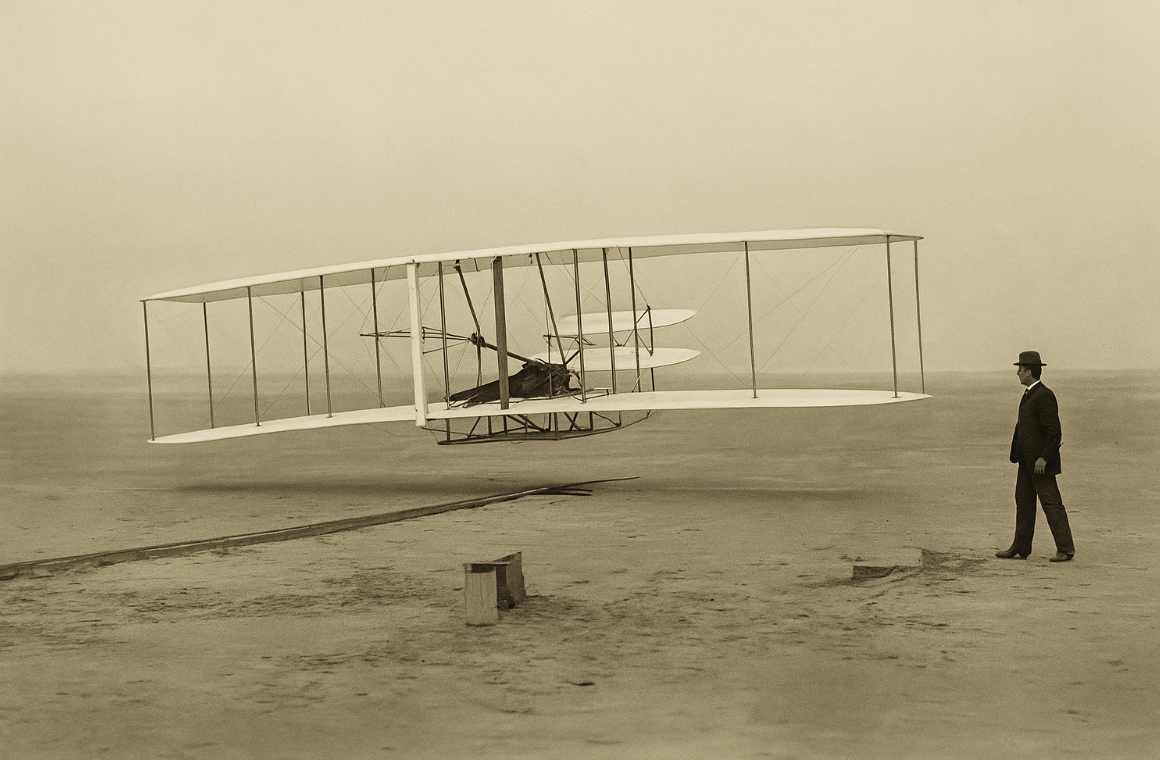
Scientific breakthroughs often precede practical applications by centuries, with progress ultimately driven not by new physics but by innovative engineering that translates discovery into use, as illustrated by the histories of flight, electricity, fire, and today’s particle collider and dark matter research.
The history of technology shows that fundamental physics often precedes practical devices by centuries. For example, Newton’s Principia (1687) laid the theoretical groundwork for flight (fluid mechanics and action–reaction principles) , and Sir George Cayley formulated the modern aeroplane concept in 1799 (fixed wings with separate lift, propulsion, control). Yet the first sustained powered flight did not occur until the Wright brothers in 1903. In other words, “the dream of flying” was long held, but engineering to build the Wright Flyer lagged by over a century (see image below). This pattern recurs elsewhere: new physics ideas (e.g. Bernoulli/Newton on lift) existed long before robust aircraft, and only with later advances in materials, engines, and controls did airplanes become practical. The image that covers this article displays the Wright brothers’ first powered airplane (1903) – an instance where centuries of theory (Newtonian physics and Cayley’s concepts) preceded practical flight.
Even spectacular breakthroughs can have short-lived impact. The Anglo-French Concorde was the only supersonic passenger jet to enter service. It first flew in 1969 and began commercial service in 1976, but was retired by 2003 . Since then no civilian aircraft has sustained supersonic flight . In effect, after Concorde’s retirement, air travel reverted to subsonic designs similar in principle to mid-20th-century jets (turbojet/turbofan engines, fixed-wing aerodynamics) rather than advancing the pace of flight. Thus, even with “new physics” (engineered materials, aerodynamics) aboard Concorde, economic and operational factors meant that supersonic transport did not become the new norm . Today’s airliners still rely on aerodynamic and propulsion principles established long ago, illustrating that revolutionary performance gains require sustained engineering support as much as scientific insight.
Electricity: Discovery to Deployment
A similar lag occurred with electricity. Concepts of electric charge have been noted since antiquity (600 BC amber/amber electrification) , but practical uses arrived slowly. For example, Alessandro Volta invented the first electric battery in 1800 , yet it took decades before engineers harnessed electricity for real work. The first telegraph did not appear until Morse’s 1844 line , and a durable incandescent light came only with Edison’s 1879 bulb . Michael Faraday’s experiments (1821–1831) created the first electric motor and dynamo principles, but generation and distribution technology matured well after (e.g. Edison’s Pearl Street station in 1882). This chronology shows that scientists understood electromagnetism long before society benefited from power grids, radios or electric lighting . In short, discovering electric phenomena was only half the story – engineering inventions (dynamos, transformers, AC systems) were needed to make electricity useful at scale.
Figure 2: Michael Faraday’s 1822 magnetic rotation apparatus (first electric motor). Faraday’s laboratory device converted electricity into motion, but widespread electrical motors and power systems only appeared decades later
Fire: Ancient Use, Modern Science
Fire exemplifies using technology with no theory. Humans controlled fire perhaps ~1 million years ago (evidence from Wonderwerk Cave) , using it for warmth, cooking and protection long before any scientific model. Yet the chemical nature of combustion remained mysterious: the Greek/phlogiston view of fire persisted until Lavoisier in 1773–1783 experimentally identified oxygen and debunked “phlogiston” . Only then did chemistry explain burning processes. In other words, early humans “used” fire effectively without understanding oxidation; the engineering (how to build and maintain fires) outpaced the physics of combustion by millennia. This underscores a general point: direct comprehension of a phenomenon is not required for practical use, but rather the right engineering methods to harness it.
Modern Frontiers: Particle Colliders and Dark Matter
These historical lessons are pertinent today. Particle colliders (e.g. CERN’s LHC) probe theoretical physics far ahead of immediate applications. The LHC (27 km ring) confirmed the Higgs boson (2012) and searches for new particles (supersymmetry, dark matter candidates). Likewise, “dark matter” – the unseen ~85% of cosmic mass – was hypothesized in 1933 (Zwicky) and by the 1970s from galaxy rotation curves, yet its nature (WIMPs, axions, etc.) is still unknown . Currently vast underground detectors and accelerators aim to discover dark-matter particles. For now the use-cases of dark matter or novel collider particles remain unclear to the public.
Nonetheless, past experience suggests we should not dismiss fundamental exploration. As the U.S. Dept. of Energy notes, decades of dark-matter searches have already driven innovations – developing new sensor materials, ultra-pure crystals, cryogenics, superconducting magnets, and advanced computing (quantum, AI algorithms) . Similarly, the World Economic Forum emphasizes that unforeseen technologies (GPS, the Internet, fiber optics) arose from pure research. For example, Einstein’s abstract relativity theory (1905–1915) later proved essential to the precision timing of GPS satellites. These lessons argue that investing in “inventions without obvious uses” can yield dividends.
Encouraging Innovative Approaches
History encourages creative, “out-of-the-box” engineering alongside basic science. We should expect that applications of new physics may be far removed from initial discoveries. As Maria Leptin (ERC) observes, “we cannot know in advance which research results will end up being useful” – but high-quality new knowledge is a necessary foundation for innovation . In practice, this means fostering environments where bold ideas can be pursued and adapted. For example:
Fundamental research without immediate payoff: Continue funding large-scale physics projects (colliders, space probes) even if their utility isn’t obvious, just as earlier particle accelerators eventually supported medical imaging and IT advances .
Cross-disciplinary collaboration: Encourage applying particle-physics tools (like cryogenic detectors or superconductors) in other fields. Past crossovers (e.g. atomic physics → MRI, accelerator magnets → maglev trains) show value.
Creative risk-taking: Promote “speculative engineering” – prizes, hackathons or fast-track grants for novel ideas using dark-matter or collider technology. For instance, consider how CERN developed the World Wide Web to meet communication needs.
By integrating lessons from aviation, electricity, and fire, we see that engineering ingenuity often unlocks the practical potential of scientific discoveries. Thus, even if a new particle or phenomenon has no clear use today, encouraging unconventional thinking – not dismissing research for lack of immediate application – is crucial. “New engineering” applied to existing physics can drive progress; history teaches us patience and imagination in bridging theory to technology
