Why Adelaide Is Emerging as Australia’s Next AI, Defence & Dual-Use Tech Hub
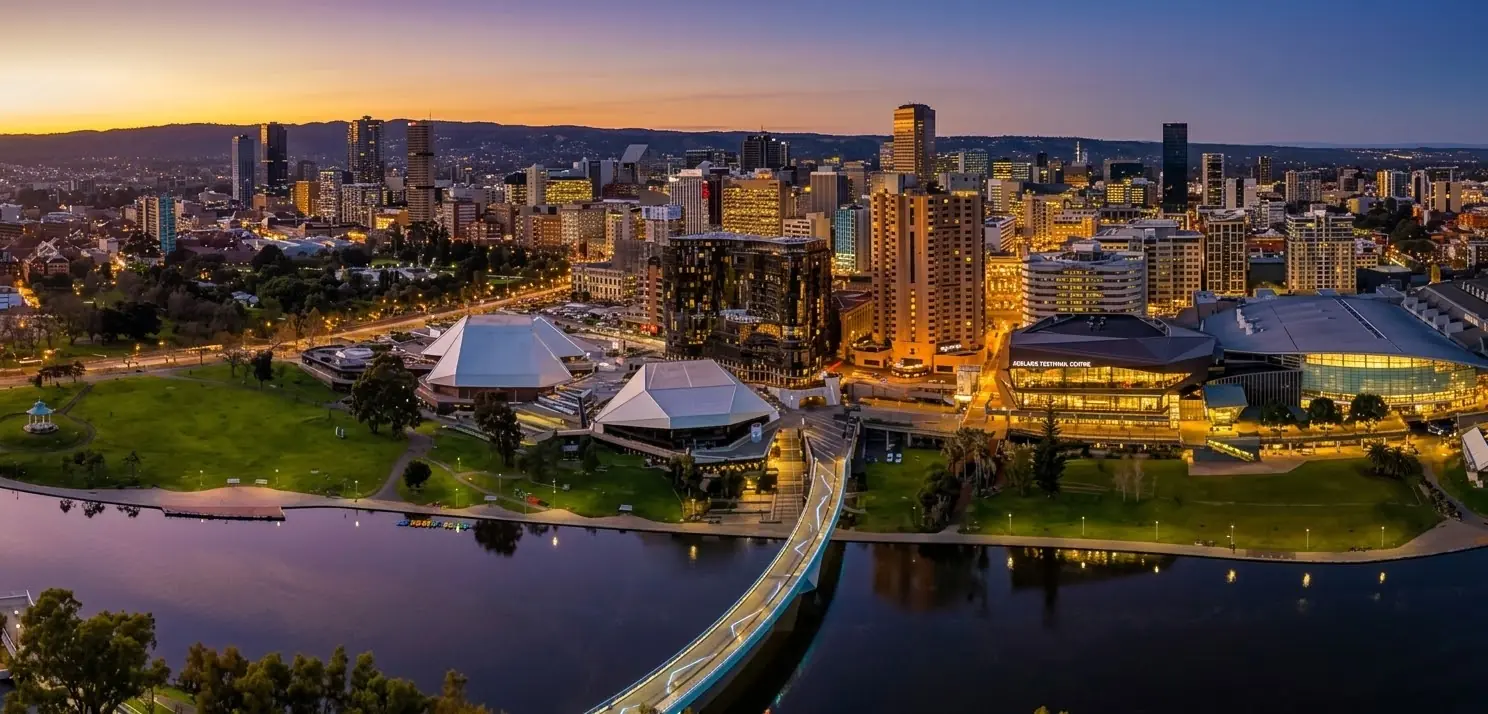
Adelaide and South Australia are rapidly emerging as a major investment hub for AI, defence, healthcare, advanced manufacturing and dual-use technologies, supported by long-term infrastructure spending, research capability and growing demand for specialised commercial development.
Australia’s next major technology cluster may be taking shape in a market historically viewed through a smaller-capital-city lens. Adelaide is increasingly becoming a convergence point for defence, artificial intelligence, space, advanced manufacturing, health technology and enterprise software — sectors whose boundaries are becoming progressively less distinct.
The investment thesis is not built around a single precinct or government program. It rests on a combination of long-duration sovereign expenditure, concentrated research capability, commercialisation infrastructure and large-scale transport, health and aviation investment. Together, these are creating the conditions for South Australia to develop one of the Southern Hemisphere’s more concentrated innovation economies on a per-capita basis over the coming decade.
Defence is the clearest structural catalyst. South Australia sits at the centre of Australia’s continuous naval shipbuilding program and the future construction of SSN-AUKUS submarines at Osborne. In July 2026, the Australian Government lifted committed investment in the nuclear-powered submarine construction yard to A$8.5 billion, while the broader submarine program is expected to support nearly 10,000 jobs in South Australia. Current planning indicates approximately A$30 billion may ultimately be required for the Osborne construction yard over coming decades. This is less a conventional project cycle than the creation of a multi-generational industrial base.
The economic spillovers should extend well beyond traditional defence contractors. Modern defence platforms depend on AI, autonomous systems, cyber security, sensing, simulation, advanced materials, data infrastructure, robotics and enterprise software. Many of these technologies have direct civilian applications. That makes Adelaide particularly relevant to investors seeking dual-use exposure: businesses able to serve defence and national-security customers while commercialising the same underlying capabilities across mining, logistics, healthcare, energy, infrastructure and other enterprise markets.
Lot Fourteen has become the most visible expression of this convergence. The CBD innovation district hosts the Australian Space Agency and Australian Institute for Machine Learning alongside defence, space, cyber and critical-technology organisations. Construction has commenced on Defence HQ, an 11-storey development scheduled for completion by the end of 2028. It will accommodate BAE Systems Australia’s South Australian headquarters, a A$60 million Australian Defence Technologies Academy, a A$24.5 million Innovation Hub and the A$20 million SpaceBase facility. The development is expected to increase Lot Fourteen’s workforce population to more than 3,000.
AI is an important component of the state’s competitive positioning. The Australian Institute for Machine Learning was the first Australian institute dedicated to advancing machine-learning research and today works across AI, computer vision and deep learning with industry and government. The significance for capital formation is not simply academic quality; it is proximity. Researchers, start-ups, defence primes, government agencies and commercial partners are increasingly being placed within the same physical and institutional network, increasing the opportunity for intellectual property to translate into investable companies and deployable systems.
Healthcare provides a second major commercialisation pathway. Adelaide BioMed City is one of the largest health and life-sciences clusters in the Southern Hemisphere, bringing together research, clinical care, education and business development. South Australia is also positioning its clinical-trials ecosystem alongside AI and digital-health capabilities. The new multi-billion-dollar Women’s and Children’s Hospital, under development within the BioMed City precinct, adds another long-duration anchor for medical technology, research and digitally enabled care. This creates potential for cross-sector innovation in computer vision, decision support, robotics, secure data systems and personalised medicine.
Crucially, the model is becoming statewide rather than precinct-specific. South Australia now identifies 20 innovation places spanning Lot Fourteen, Adelaide BioMed City, Tonsley, Osborne, Edinburgh and university and manufacturing precincts. The state projects that this connected network could add A$6.4 billion to the economy over ten years, create around 2,000 jobs annually and support employment for more than 42,000 people. If realised, this network effect may become one of South Australia’s principal advantages: a relatively compact market capable of connecting government, capital, research and industry more tightly than larger but more fragmented cities.
Real estate must become part of the technology strategy
The physical economy will need to evolve alongside the technology economy. Adelaide’s real-estate market should therefore increasingly be viewed as enabling infrastructure, rather than simply a secondary beneficiary of economic growth.
Incoming defence, AI, healthcare and advanced-manufacturing businesses will require secure offices, laboratories, prototyping facilities, high-specification industrial space, controlled environments, reliable power and data infrastructure, and locations connected to Osborne, Edinburgh, Lot Fourteen, BioMed City and the airport. The market is already showing pressure in industrial supply: CBRE reported leasing activity strengthening during 2026, with constrained serviced industrial land, elevated development pre-commitments and defence-related investment supporting demand. At the same time, Adelaide’s CBD office vacancy remains relatively elevated, suggesting the opportunity is not indiscriminate new supply but the repositioning and development of assets suited to sophisticated technology occupiers.
This creates a corresponding opportunity for developers and institutional capital. Property groups, venture-backed companies, defence primes, universities and infrastructure investors may increasingly need to coordinate through joint ventures, pre-commitments, build-to-suit developments and commercially aligned precinct strategies. As domestic and international technology investment enters South Australia, the realty market will need to anticipate where those companies intend to operate—not react after capacity constraints emerge.
Supporting infrastructure reinforces that investment case. Adelaide’s A$15.4 billion River Torrens to Darlington motorway project, scheduled to open in 2031, will strengthen access to Adelaide Airport, Port Adelaide and the national highway network. Adelaide Airport’s A$600 million Project Flight is simultaneously expanding terminal and aviation capacity through 2028. These projects increase the city’s ability to absorb people, capital and commercial activity while improving the connectivity required by export-oriented technology and advanced-industry businesses.
The next decade will test execution. Skills shortages, housing supply, specialised property availability, infrastructure delivery and competition for global capital remain material constraints. Yet South Australia’s direction of travel is increasingly difficult to dismiss.
Adelaide is moving from being viewed principally as a cost-competitive secondary market toward becoming a strategically relevant technology and industrial node. For investors, developers and corporate partners, the emerging opportunity is not merely participation in individual projects. It is exposure to an ecosystem being built around some of Australia’s most durable long-term themes: sovereign capability, AI adoption, defence modernisation, health innovation and the commercialisation of dual-use technology.
The next decade of South Australian growth therefore has the potential to be defined not simply by infrastructure expenditure, but by the wealth, intellectual property and new industries created around it.