Mind controlled human machine interfaces
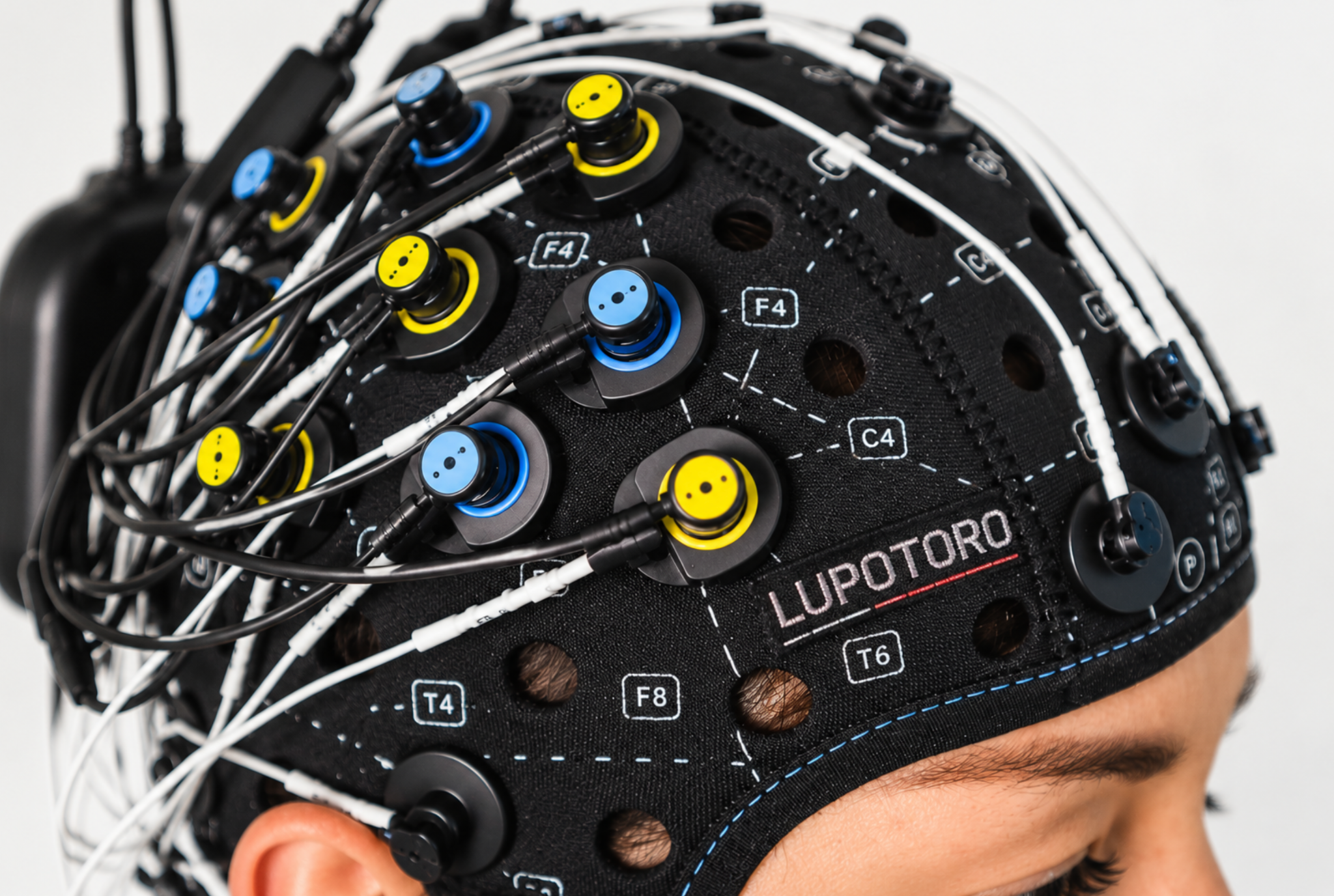
Neural intention decoding adaptive feedback and assured shared control
Abstract
We examine how a human–machine interface can translate a restricted set of deliberate neural intentions into useful, accountable action. Using scientific literature published by 31 August 2021, we compare non-invasive EEG selection and physical control with implanted handwriting, speech and robotic interfaces. The evidence establishes meaningful capabilities under specified conditions, while small samples, calibration dependence, contextual assistance and incompatible performance measures constrain generalisation. We critically evaluate neural feedback, distinguishing regulation of a measured rhythm from transferable improvement in task performance. Our proposed architecture separates command inference, operator-state estimation, predictive machine modelling and action authority. It combines explicit abstention, bounded shared control and feedback grounded in measured execution. We formulate five falsifiable hypotheses and a staged programme addressing signal contamination, contextual leakage, coadaptation, rare unintended commands, retention and independent replication. Illustrative Bayesian and reliability calculations show why high accuracy or zero observed failures can be misleading when command opportunities are rare. A dedicated section carries forward the measurement lessons of our internal research baseline dated 9 December 2015, including the distinction between responsiveness, awareness, report and independently verified information. Aerospace and defence-adjacent sections assess supervisory interaction, operator support, rehabilitation and neurosecurity without treating laboratory demonstrations as operational qualification. We conclude that development should proceed through narrowly defined applications with a measurable human contribution, transparent uncertainty and independently verified outcomes. The architecture, hypotheses and experimental programme are our synthesis and proposals; the manuscript reports no new participant experiments or validated LupoToro prototype.
Contents
Reading the study
Sections 1 to 5 establish the evidence and measurement limits. Sections 6 to 9 develop the architecture and test programme. Sections 10 to 12 examine aerospace applications, the internal research baseline and defence-adjacent development. The appendix records the principal consistency checks.
1 Research question and central argument
We propose a development programme for human–machine interfaces that infer a limited set of deliberate intentions from neural activity, return useful sensory feedback and execute commands through a separately assured controller. Our central argument is that intention decoding, operator-state estimation and permission to act must remain distinct. A neural pattern may predict fatigue without expressing an instruction. A classifier may recognise an instruction without establishing that the requested action is feasible. A machine may describe its own state without possessing subjective experience. Treating these distinctions as architectural requirements gives the programme both a scientific question and an engineering discipline.
The research question is therefore specific: under what conditions can neural measurements improve a person’s effective control of a machine, after accounting for unintended activation, training burden, feedback effects, automation assistance and uncertainty about the person’s current capacity? We evaluate the evidence available by 31 August 2021. Our intended applications include assistive communication, robotic interaction, aerospace simulation, operator support and rehabilitation relevant to defence personnel. These applications differ in acceptable latency, reversibility and consequence; a successful demonstration in one cannot establish readiness in another.
We use “mind controlled” as an accessible description of a constrained communication channel. The scientific object is a brain–computer interface, or BCI, whose output depends on measured brain activity. This does not imply unrestricted access to private thoughts. Foundational BCI research describes systems for communication and control through signals that users may learn to regulate or that reflect their responses to selected stimuli (Wolpaw et al., 2002). The channel is jointly determined by the person, task, sensor, training data, decoder and surrounding interface.
Our contribution is an original synthesis and proposed programme, not a report of newly collected LupoToro experiments. We develop an architecture that combines deliberate neural commands, an independent estimate of operator state, a predictive model of machine behaviour and explicit action constraints. We then specify experiments capable of showing that particular components add value, including experiments in which our preferred hypotheses could fail. The resulting research agenda concerns measurable control and accountable inference. Claims about the existence or transfer of consciousness are outside what the reviewed experiments can establish.
2 Evidence selection and inferential method
The evidence boundary
We restrict the external scientific references to works published on or before 31 August 2021. Where a paper appeared online before its journal issue, we checked its publication record and retained only work accessible within that boundary. The three principal 2021 demonstrations considered here appeared in May or July. No later experimental findings are used to strengthen the assessment. The internal citation dated 9 December 2015 identifies a retrospective evidence baseline, explained in Section 11; it does not assert that the present manuscript or the earlier synthesis was physically published on that date.
This is a critical, purposive evidence synthesis. It is not a preregistered systematic review, and we do not claim an exhaustive database search or a quantitative meta-analysis. Searches targeted original demonstrations of EEG control, implanted communication, sensory feedback, neurofeedback, operator monitoring, self-modelling and shared control. We checked journal or author records, DOI metadata, accessible full texts and original abstracts. Where only an abstract or publisher excerpt was available, we confined empirical descriptions to information present in that record. We did not obtain individual participant datasets or reproduce the published signal-processing pipelines.
We selected evidence for its ability to distinguish mechanisms and expose development constraints. Positive demonstrations establish what has been achieved under specified conditions. Controlled null findings identify limits on generalisation. Reviews supply conceptual organisation and methodological context, while individual experiments remain the basis for numerical claims. The external bibliography consists of journal publications and one peer-reviewed conference paper; the separately identified internal synthesis is not treated as independent experimental replication.
Four levels of claim
We distinguish an observed association, a demonstrated functional capability, a causal intervention effect and an operationally dependable system. A relationship between EEG power and task condition is an association. Selecting a target online establishes a capability within that task. Improvement under a properly controlled feedback manipulation may support a causal effect. Dependable operation additionally requires evidence about failures, unanticipated inputs, sensor deterioration, long-term use and interaction with other systems. These levels are related, but evidence at one level does not automatically satisfy the next.
For each study we ask what was measured, who contributed independent observations, what comparison was available, whether performance was online, and which ordinary pathways could account for success. We also ask whether the human’s contribution can be separated from the machine’s prior knowledge. A language model can improve a sentence without increasing the information extracted from the brain; an autonomous navigator can complete a route after receiving only a destination. Both can be valuable, provided their contributions are measured separately.
Our quantitative examples are transparent calculations from stated assumptions. They are not estimates of LupoToro prototype performance. Proposed sample sizes illustrate planning logic; they do not replace variance estimates from a relevant pilot study. Likewise, the engineering requirements below are research proposals rather than certified specifications. Throughout the paper, “we propose” identifies a design decision or hypothesis, while published observations retain their source attribution.
3 What the interface can and cannot measure
Deliberate commands and passive observations
Active BCIs typically rely on intentionally generated activity, such as motor imagery. Reactive BCIs use responses to external stimulation, such as attending to a flickering selection target. Passive BCIs estimate aspects of a user’s state without requiring that the state be deliberately produced as a command. Zander and Kothe (2011) articulate the passive category as a route to broader human–machine adaptation. We retain these categories because they entail different interpretations of the same electrical observation.
An increase in an EEG feature during difficult work might support an estimate of workload. It does not authorise the system to choose a destination, alter a flight path or communicate agreement. Conversely, a deliberate selection may remain valid while workload is high. We therefore propose separate output vocabularies: the command decoder returns candidate intentions and an abstention state; the state estimator returns uncertain descriptions of task-related condition. The controller receives both, but only an explicitly enabled command channel can request an action.
The observation itself is a mixture. Scalp signals depend on neural activity, electrode contact, movement, ocular activity and muscle activity. Whitham et al. (2007) used recordings during neuromuscular blockade in two participants to demonstrate substantial muscle contributions above 20 Hz. That experiment does not make every high-frequency EEG result artifactual. It does make an untested assumption of neural purity untenable. We require simultaneous nuisance measurements and conditions that deliberately challenge the decoder with movement, gaze changes and muscle activity.
Brain rhythms are conditional measurements
Frequency-band labels do not provide a dictionary of mental contents. Klimesch (1999) shows why alpha and theta relationships must be interpreted in relation to task, baseline, individual frequency and the distinction between ongoing and event-related activity. A feature useful in one setting may reverse its relationship to performance in another. We consequently avoid defining a universal “optimal mind state” from a fixed ratio or a single frequency threshold.
Reverse inference creates a related problem. Knowing that a cognitive process can produce a neural pattern does not establish that the process is present whenever that pattern appears. The inference also depends on how selectively the pattern occurs and on the prior probability of the process (Poldrack, 2006). For development, this means that a workload classifier must be tested against plausible alternative causes of its signal. Matching a laboratory label is insufficient if the same feature responds to eye closure, physical effort or a change in display luminance.
Four meanings of feedback
We distinguish feedback about an executed action, feedback about the decoder’s interpretation, feedback intended to train neural self-regulation, and direct stimulation of neural tissue. The first might show that a robotic gripper closed. The second might show which command is currently most probable. The third might provide a tone contingent on a measured EEG feature. The fourth uses an implanted or other stimulation technology with a different intervention and evidence base. These channels can coexist, but their mechanisms and risks cannot be pooled into a single claim that “feedback improves control.”
The distinction matters experimentally. A person may benefit from seeing what a decoder selected even if no enduring neural learning occurs. A rewarding sound may improve motivation even when it is not contingent on brain activity. Tactile information may improve object handling because it supplies missing sensory evidence. Our programme measures these explanations separately and preserves a no-command state throughout. Silence, uncertainty and failure to decode are outcomes requiring interpretation; none should be silently converted into agreement.
4 Experimental capability before the cutoff
Comparative evidence
Table 1 Selected demonstrations and the limits of transfer
Study |
Interface and sample |
Reported performance |
Boundary of the evidence |
|---|---|---|---|
Chen et al. 2015 |
Visual SSVEP spelling with EEG; 12 online participants |
Mean cued-test rate 4.45 bits per second |
Stimulus-driven selections in a calibrated laboratory task |
LaFleur et al. 2013 |
Motor-imagery EEG; five trained participants |
Individual target acquisition up to 90.5 percent |
Small flying robot in a controlled environment |
Willett et al. 2021 |
Intracortical attempted handwriting; one participant |
90 characters per minute; 94.1 percent raw online accuracy |
Participant-specific implanted system |
Moses et al. 2021 |
Cortical speech decoding; one participant |
Median 15.2 words per minute; 25.6 percent word error |
Constrained vocabulary and language assistance |
Flesher et al. 2021 |
Implanted motor decoding and tactile stimulation; one participant |
Median task time 20.9 to 10.2 seconds |
Particular robotic manipulation task and sensory pathway |
These figures answer different questions. Characters per minute, word error, information transfer and target acquisition are not interchangeable measures. None records the complete cost of preparation, calibration, supervision, corrections and failed sessions. A scientifically useful comparison must first hold the task, opportunity to act and consequence of error sufficiently constant. Table 1 is therefore a capability map, not a performance league table.
Visual selection and continuous physical interaction
Chen et al. (2015) encoded 40 visual targets using frequency and phase. Their online cued-testing mean was 91.04 percent accuracy, corresponding to 4.45 bits per second with one-second trials. The often-quoted 5.32 bits per second is an upper performance figure, not the group’s observed test mean. The experiment establishes rapid selection through a carefully structured sensory channel. Our interpretation is that its strongest engineering lesson concerns joint design of stimulation, calibration and decoding. Its dependence on visual presentation makes transfer to visually demanding tasks an empirical question, especially where gaze is already needed for navigation.
LaFleur et al. (2013) trained five people to regulate sensorimotor rhythms while navigating a quadcopter using video feedback. The reported upper target-acquisition result was 90.5 percent, with an average straight-line speed of 0.69 metres per second. This demonstrates physical interaction beyond a screen cursor. We do not infer from it reliable flight control across weather, degraded communications or untrained operators. Our proposed comparison would ask whether a neural supervisory channel adds utility beyond a matched conventional interface while the same underlying vehicle controller is held constant.
The two cases expose an important trade-off. Structured stimulation can make intentions easier to distinguish, but occupies sensory resources. Internally generated control can avoid continuous stimulus selection, but imposes learning and calibration demands. Choosing between them requires a task analysis, not a general preference for the interface that appears more “mental.” We would evaluate both against the person’s remaining communication abilities and the environment’s competing attentional demands.
Implanted communication and the role of prior information
Willett et al. (2021) decoded attempted handwriting from one participant’s motor-cortical activity. Their raw online result was 94.1 percent character accuracy at 90 characters per minute; accuracy above 99 percent was obtained with general-purpose autocorrection applied offline. The distinction matters because an offline enhancement cannot be reported as the online decoder’s unassisted performance. We infer that rich attempted movements can contain useful sequential structure, while the suitability of implantation and generalisation across users remain separate questions.
Moses et al. (2021) studied attempted speech in one person with anarthria using cortical surface recordings and a 50-word vocabulary. The median output rate was 15.2 words per minute when all decoded words were counted, or 12.5 when only correct words were counted. Median word error was 25.6 percent with language modelling and 60.5 percent without it. This demonstrates communication within a bounded task and makes the contribution of contextual assistance measurable. It does not establish unrestricted semantic access. Our proposed evaluations likewise expose vocabulary constraints and language priors.
We propose a practical counterfactual test: compare the complete system with a context-only model, a neural-only model and a system receiving deliberately mismatched neural segments. If the context-only model succeeds almost as often, the application may still be useful, but the claimed contribution of neural decoding is small. If mismatched neural signals leave performance unchanged, the system is not demonstrating the intended neural channel. These are proposed attribution tests; they are not claims that the cited experiments failed such controls.
Sensory return and embodied control
Flesher et al. (2021) supplied tactile sensations through intracortical stimulation while a participant controlled a robotic arm. Median task time fell from 20.9 to 10.2 seconds, a reduction of approximately 51.2 percent. The result supports the value of task-relevant sensory information within that bidirectional implanted system. It does not validate an acoustically delivered EEG-training protocol. We take from it a design question: which missing variable must the person perceive to correct the action efficiently?
An earlier implanted study demonstrated seven-dimensional robotic control by one participant with tetraplegia after training (Collinger et al., 2013). Together, these cases justify continued work on useful motor interfaces, while their small participant counts constrain population-level predictions. Repeated successful trials improve knowledge about performance for the studied person; they do not turn one participant into a large independent sample. Our proposed programme therefore reports participant-level variation, unsuccessful calibration and retention alongside successful trials.
5 Neural feedback and the causal claim of improvement
What the supportive evidence establishes
Neurofeedback supplies a person with information derived from their own neural activity and may support learning to regulate selected features. Sitaram et al. (2017) review the mechanisms, learning processes and clinical research underlying this approach, while identifying unresolved questions about specificity and efficacy. For an interface developer, the essential distinction is between changing the feedback variable and improving the task that matters. A display can reward a measurable change without showing that the change helps communication, navigation or recovery.
Zoefel, Huster and Herrmann (2011) trained upper-alpha activity in 14 participants over five sessions and reported cognitive improvement relative to a control condition without neurofeedback. Eleven trainees showed the specified training response. This provides supportive evidence, but the absence of a convincing matched feedback condition limits separation of contingency-specific learning from practice, expectation and engagement. We would retain it as a rationale for a controlled experiment, not as a general assurance that increasing alpha improves performance.
Ngo et al. (2013) used phase-aligned auditory stimulation during sleep and reported enhancement of slow oscillations and memory. This intervention concerned the timing of cues relative to a sleep rhythm. It was not generic audio exposure and did not demonstrate improved wakeful operator control. Its relevance to our programme is mechanistic: the timing and physiological context of a feedback signal can be part of the intervention, rather than incidental delivery details.
A controlled counterexample
Schabus et al. (2017) tested sensorimotor-rhythm neurofeedback against placebo feedback in 25 people with insomnia using a double-blind, counterbalanced design. Subjective improvement occurred in both conditions, without a specific advantage in the objective sleep outcomes. The participants could modulate the rewarded rhythm during training, yet this did not establish the intended sleep benefit. The study narrows claims about that protocol and population; it does not demonstrate that every neurofeedback application is ineffective.
This result motivates a causal model for our own research. The intervention can affect the measured neural feature, expectations, effort, motivation and task practice. Each may influence the outcome. A successful training curve alone cannot identify which pathway produced a behavioural change. A favourable self-report is also insufficient when the operational claim concerns fewer erroneous commands or better hazard detection. We therefore propose separate outcomes for feature regulation, retained learning without feedback and externally scored task performance.
Testing contingency rather than spectacle
We propose three conditions: genuinely contingent feedback, yoked feedback derived from another comparable session, and a task-practice condition with matched contact time. The first two must have similar reward frequency, salience and apparent plausibility. Otherwise, participants may identify their allocation or receive different encouragement. Outcome assessors should be masked to assignment, and the study should record allocation guesses and expectations rather than assuming that an intended blind remained effective.
The CRED-nf consensus specifies reporting and design expectations that help distinguish intervention-specific effects from other influences, including controls, blinding, neural learning and behavioural outcomes (Ros et al., 2020). We use these principles to make the proposed trial auditable. The primary comparison would concern a prespecified control task after training, not the most favourable EEG feature found afterwards. Neural change is a secondary mechanistic endpoint unless the trial is explicitly designed and powered to test mediation.
An auditory feedback channel also has an opportunity cost. It can occupy attention, create expectations or compete with another signal. In our architecture, feedback is optional, interruptible and subordinate to the task’s alerting requirements. We would measure benefit after accounting for those costs. A small improvement during uninterrupted laboratory training would not justify continuous feedback during an operation requiring rapid recognition of critical alarms.
6 Proposed development architecture
Separation of inference and authority
We propose a modular system in which a command decoder estimates intentional selections, an operator-state model estimates task-related condition, and an action arbiter decides which requests may proceed. A predictive model estimates the machine’s expected next state. A feedback manager reports the selected command, actual execution and relevant uncertainty. The modules exchange time-stamped outputs, but their meanings remain explicit. A state estimate cannot be promoted into a command simply because the two happen to correlate in the training data.
The acquisition module should retain sufficient information to identify signal-quality failures. We propose recording EEG with synchronised eye and muscle measurements during development, together with electrode-quality indicators and task events. Preprocessing must preserve causality for online use: future samples cannot be used to improve a prediction presented as real time. The live processing chain, including filter delays and buffering, must match the evaluated chain. A model that works on retrospectively cleaned recordings is not yet a working online interface.
The command decoder should produce calibrated probabilities over permitted intentions and an explicit abstention outcome. The operator-state model should report uncertainty and the context in which it was validated. The action arbiter should know the machine’s current state, permitted actions, recent accepted commands and whether control is enabled. Acceptance should require adequate signal quality, sufficient evidence, a valid action context and an appropriate authorisation state. For actions with greater consequences, we propose an additional confirmation mechanism whose independence is experimentally assessed.
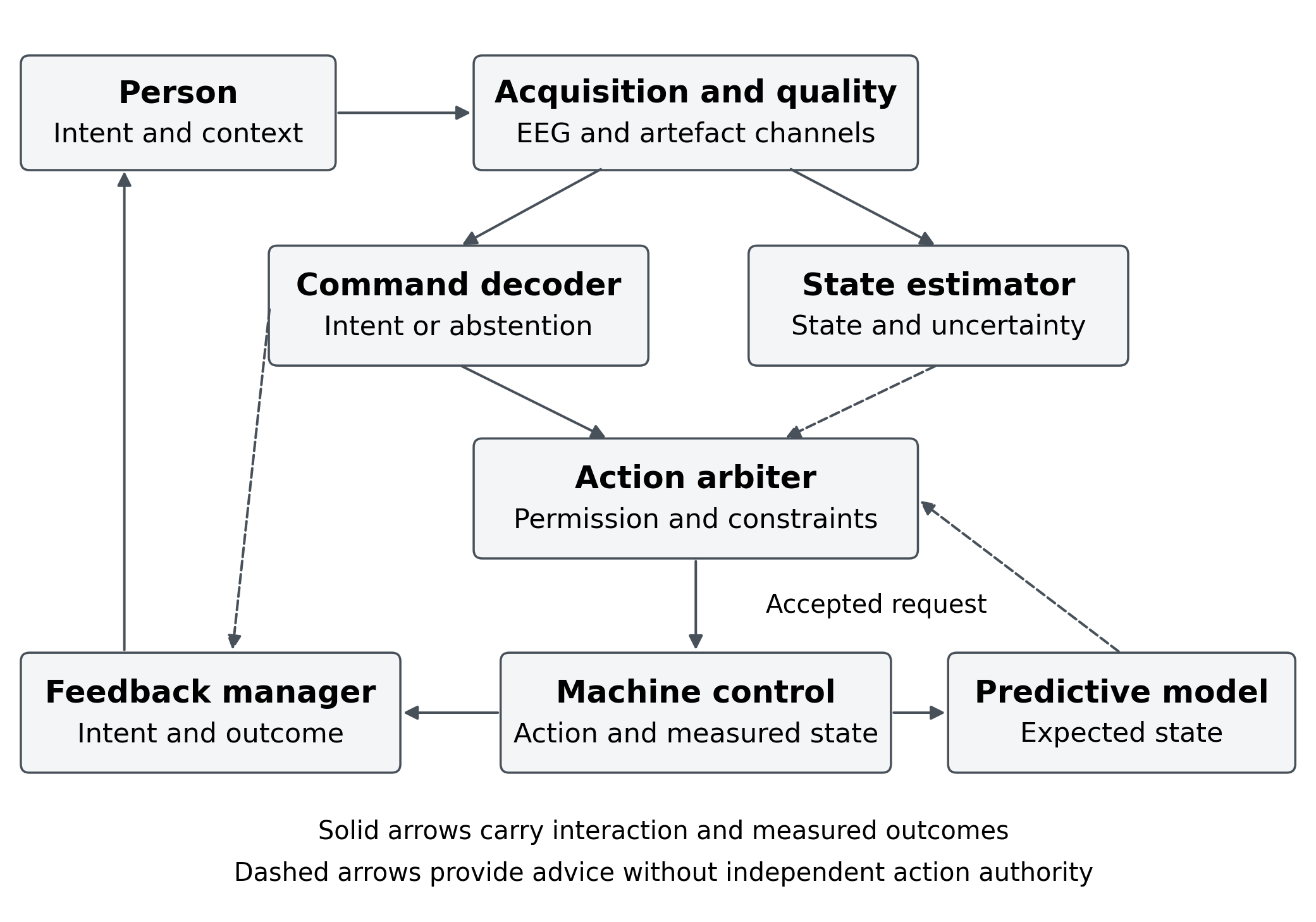
Figure 1 Proposed separation of neural inference physical control and feedback
Shared control with a measurable human contribution
Shared control allocates different parts of a task between the person and automation. Millán et al. (2010) explain how combining BCIs with assistive technologies can support useful interaction despite limitations of the neural channel. We propose that the person select an intention at the level the channel can reliably support, while conventional control handles faster stabilisation and obstacle constraints. This can improve task performance without pretending that every actuator command originated in the person’s brain.
The allocation must be visible to the user. If the person requests a destination and the machine chooses a route, the interface should communicate both the accepted destination and the machine’s plan. If the plan is revised, the system should identify the revision and allow an appropriate opportunity to cancel. A machine’s fluent explanation cannot substitute for this record. We require logs that preserve the candidate neural command, accepted command, constraints applied, executed action and measured outcome as separate events.
We propose an agency measure based on whether intended outcomes are achieved, whether unintended actions are recognised and whether corrections are effective. This is different from merely asking whether the person felt in control. Subjective agency remains an important outcome, but it should be compared with behavioural evidence. A system that creates a convincing sense of authorship while its actions depend almost entirely on contextual priors would fail our intended interpretation even if users liked it.
Feedback and adaptation
We would display the decoder’s provisional interpretation before an action becomes consequential where the task permits this delay. Action feedback would then reflect measured execution rather than the command alone. A gripper icon should not indicate successful grasp merely because “close” was transmitted; contact or object-state evidence is required. This design makes transmission failure, actuator failure and decoding error distinguishable.
Adaptation should also be separated by purpose. Updating electrode normalisation is different from changing the command decision boundary, and both differ from modifying an action policy. During confirmatory evaluation, we propose a versioned adaptation rule with a frozen acceptance policy. Any update must be reproducible from retained data and must not learn from its own unverified guesses as though they were ground truth. Where independent labels are unavailable, the system should favour abstention and supervised recalibration over silent drift.
The person and decoder are coupled learners. A decoder update changes the feedback the person encounters, which may change the strategy used to generate the next signal. Improvement cannot therefore be assigned to the algorithm merely by observing a later session. We propose alternating prespecified adaptation and evaluation periods, retaining a frozen decoder comparison and testing transfer after a pause. This would help distinguish useful coadaptation from a fragile interaction that works only while both components continually compensate for each other.
7 Mathematical formulation and machine self modelling
A conditional inference problem
Let Y denote the measured neural signal, Z measured nuisance variables, C task context, I deliberate intention, S operator state and X machine state. We propose estimating a command posterior p(I given Y, Z, C) and a separate state posterior p(S given Y, Z, C). Neither quantity is a direct measurement of subjective experience. The distinction is semantic as well as statistical: I has a restricted command vocabulary, while S describes conditions relevant to performance.
Separate modules do not make their errors statistically independent. Both can respond to the same electrode fault, nuisance signal or contextual shift. Multiplying their confidence estimates as though they supplied independent confirmation would be unjustified without a dependence model. We propose evaluating their joint errors under controlled perturbations. If two intentions produce indistinguishable observations in the available task, a more elaborate classifier cannot resolve that non-identifiability; the task, measurement or available command set must change.
Here PPV is the probability that a command is present given a positive detection, Se is sensitivity, Sp is specificity and π is command prevalence. This binary illustration concerns a defined detection opportunity, not an entire operating hour; identifying the correct command within a multiclass vocabulary requires an additional analysis. At prevalence 0.001, sensitivity 0.95 and specificity 0.99, only about 8.7 percent of detected command events would be true command events. Increasing specificity to 0.9999 raises that figure to about 90.5 percent. High accuracy in a balanced task can therefore coexist with unacceptable behaviour during prolonged inactivity.
Table 2 Illustrative effect of rare command opportunities
Assumed sensitivity |
Assumed specificity |
Command prevalence |
Positive predictive value |
|---|---|---|---|
95 percent |
99 percent |
0.1 percent |
8.7 percent |
95 percent |
99.99 percent |
0.1 percent |
90.5 percent |
We do not infer operational false-command rates directly from this table. Real decoding windows overlap, errors cluster and opportunities to act depend on interface state. We instead propose measuring accepted unintended commands per hour of representative non-command behaviour, together with missed intended commands and correction time. Confirmation can improve reliability, but two confirmations from the same noisy signal are not independent evidence. Their joint error distribution must be measured.
Probability calibration deserves separate validation. Guo et al. (2017) demonstrated calibration methods for modern neural networks in non-BCI settings. We propose testing such methods on held-out neural-interface sessions rather than assuming their transfer. The relevant question is whether events assigned a stated probability occur at approximately that rate in the intended use conditions. Calibration under one distribution does not establish calibration after electrode displacement, fatigue or a new task.
Predictive models without a consciousness claim
An internal forward model predicts the sensory consequences of an action and can support comparison between expectation and observation. Wolpert, Ghahramani and Jordan (1995) provide experimental support for internal modelling in human sensorimotor integration. In robotics, Bongard, Zykov and Lipson (2006) demonstrated a machine that revised its model of its own structure and adapted locomotion after damage. These results motivate functional self-modelling; neither establishes that a machine has subjective experience.
We propose a machine model with explicit state variables for geometry, actuator condition, available resources, uncertainty and recent interaction history. It predicts candidate outcomes and compares them with independent sensor observations. A mismatch should change confidence or trigger a constrained recovery procedure. The model’s “self” is an engineering representation of the controlled system. Its adequacy is tested by predictive accuracy and useful fault response, not by how persuasively it describes itself.
Dehaene, Lau and Kouider (2017) distinguish global availability of information and self-monitoring as computationally relevant aspects of consciousness research. We use that distinction to organise information access and confidence monitoring, without treating implementation of either function as proof of phenomenal consciousness. A module can report uncertainty, retain episodic records and compare alternatives while the philosophical question of experience remains unresolved.
Temporal prediction also does not identify causation by itself. If a machine observes that an action usually precedes an event, an unmeasured variable may explain both. Our proposed self-model therefore distinguishes passive prediction from intervention-based learning. Controlled simulation can vary an action while holding the environment constant; physical trials require additional constraints and independent outcome measurements. We would reward improved prediction under such tests, rather than reward a post hoc narrative that accommodates every outcome.
Bounded execution
For a research controller whose state derivative equals f(X) + g(X)u, define an admissible region by h(X) greater than or equal to zero. A candidate action from the interface is filtered through a constrained controller. A simplified formulation is:
Ames et al. (2017) develop control-barrier-function methods that combine performance objectives with constraints supporting forward invariance under specified assumptions. Here α is a suitable increasing function with α(0) = 0. The formulation requires appropriate regularity of the dynamics and barrier function, an initial state in the admissible region, and feasible control inputs within actuator limits. Our expression is an architectural illustration, not a verified controller for an aircraft. Its intended protection also depends on state estimation and implementation timing. Unmodelled dynamics or an infeasible optimisation can invalidate it.
We therefore propose a monitored fallback and explicit tests of infeasibility, delay and estimator error. The neural decoder supplies a requested action; it does not define the physical admissible region. This separation allows the research programme to improve the neural channel without repeatedly changing every underlying control assumption. It also makes failures attributable: a wrong decoded request and a controller that fails to enforce its specified boundary are different defects requiring different remedies.
8 Five falsifiable development hypotheses
Hypothesis 1 Separating state and intention reduces unintended actions
We predict that a decoder with an explicit non-command state, quality rejection and independent operator-state estimation will produce fewer accepted unintended actions than a matched classifier that always selects a command. The comparison must hold intended-command opportunity, task difficulty and acceptable response delay constant. Primary outcomes are unintended accepted actions per idle hour and correctly completed intended actions. The hypothesis fails if the apparent gain depends entirely on suppressing useful commands or imposing an unacceptable delay. We would report the entire trade-off, not a single favourable threshold.
Hypothesis 2 Shared control preserves useful agency
We predict that bounded shared control will increase successful task completion relative to direct neural control while preserving the person’s ability to choose and revise the task goal. The decisive comparison includes a context-only controller and neural-signal mismatch trials. Success requires both better completion and a measurable dependence on the person’s intended goal. The hypothesis fails if autonomous task priors explain the improvement while independent tests show little contribution from neural input, or if correction becomes materially harder despite faster completion.
Hypothesis 3 Contingent feedback produces transferable improvement
We predict that genuinely contingent neurofeedback will improve a prespecified control outcome more than plausible yoked feedback after equal practice and contact time. A retained benefit during a later session without feedback is more informative than a transient change in the rewarded feature. The hypothesis fails if groups differ only in subjective engagement, if the neural feature changes without useful performance improvement, or if a result disappears when expectations and reward frequency are matched. Any proposed neural mediation would require a separately justified analysis.
Hypothesis 4 Independent outcome feedback improves error recovery
We predict that feedback based on measured execution, combined with a predictive machine model, will improve detection and recovery from mismatches between intended and executed actions. The experiment would introduce controlled communication delays, cancelled commands and benign actuator discrepancies in simulation. We compare actual-state feedback with command-echo feedback while matching presentation. The hypothesis fails if apparent benefits come only from extra warnings or added observation time. A favourable result would support accountable control, not a claim that the machine experiences its own actions.
Hypothesis 5 Staged handover outperforms a single responsiveness trigger
We predict that a handover protocol testing orientation, command comprehension, cancellation and a simple representative task will better identify readiness for control than a single behavioural response or a single EEG threshold. We would first test this during ordinary workload changes, fatigue protocols within approved limits and simulated interruptions. No inference about post-arrest recovery is required for the initial experiment. The hypothesis fails if the additional assessments do not improve prediction of subsequent performance enough to justify their delay and workload.
These hypotheses are complementary but should not be tested as one undifferentiated “mind-control” intervention. A positive system-level result could conceal an ineffective feedback component or a decoder that contributes little beyond automation. Component comparisons should precede a final integrated assessment. We propose making failure of a component hypothesis a reason to simplify the design, rather than a reason to redefine the original endpoint after inspection of the data.
9 Experimental programme and analysis
Stage one Signal validity and feasible interaction
We propose an initial feasibility cohort of approximately 24 participants completing repeated sessions. This is a planning choice intended to reveal practical variation and failure modes; it is not a claim of statistical power for the hypotheses. The cohort should include variation relevant to the intended task and record reasons for exclusion, unusable recordings and failure to learn the interface. An assistive application would require a separate study with intended users, because results from healthy volunteers do not establish performance in paralysis or neurological illness.
Sessions would include deliberate commands, ordinary inactivity, conversation, eye movement, muscle activation and representative distractors. The command set should initially be small and reversible. We would retain a conventional input method for task comparison, hold automation assistance constant, and record preparation time, calibration time, workload, errors and correction burden. Performance after the first successful session is insufficient; retention and recalibration across days must be measured.
Signal validity requires controls tailored to the acquisition pathway. Eye and muscle channels should be tested as alternative predictors. A classifier trained only on nuisance variables provides a useful diagnostic comparison. Spatial filtering and feature selection must be fitted using training data alone. All filtering used for the live claim must be causal or have its delay explicitly included. Cue timing, screen refresh and feedback signals must be checked for inadvertent task-label leakage into recorded channels.
Stage two Decoder comparison without leakage
Lotte et al. (2018) review EEG classification approaches and the importance of adaptation and evaluation across changing conditions. We propose comparing a modest baseline with more complex models before adopting a deep architecture. Barachant et al. (2012) provide a covariance-based Riemannian approach, while Lawhern et al. (2018) introduce EEGNet as a compact convolutional model. These are candidate method families, not evidence that any one will dominate our task. Complexity must earn its place through held-out performance and maintainability.
Training, tuning and final evaluation should be separated at the unit corresponding to the intended claim. A claim about a new day requires whole days held out. A claim about a new person requires people held out. Randomly distributing neighbouring windows between train and test can leak session-specific structure. We propose nested selection of preprocessing and hyperparameters, with the final test set inaccessible until the analysis specification is frozen.
Varoquaux (2018) demonstrates why small neuroimaging samples can produce unstable cross-validation estimates and misleadingly narrow uncertainty. We consequently treat participants and sessions as clusters rather than pretending that thousands of overlapping windows supply thousands of independent people. We would report participant-level distributions and uncertainty intervals, alongside pooled summaries. Failed calibrations and unusable sessions remain part of the denominator relevant to deployment, even when a secondary analysis examines successful users separately.
Stage three Controlled component trials
We propose a randomised within-person comparison for reversible interface policies, with counterbalanced order and prespecified carryover checks. Persistent neurofeedback learning requires a different design: a parallel-group study may be preferable because training effects may survive a nominal washout. These experiments should have separate primary outcomes and analysis plans. Pooling them would obscure whether an effect came from the decoder, the action policy or learned neural regulation.
For a planning illustration, suppose a paired primary outcome has a standardised within-person effect of 0.35, power of 90 percent and a two-sided significance level of 0.01. A normal approximation gives:
Rounding gives 122 completers; allowing 15 percent attrition gives 144 recruits. These numbers are not a recommended final sample size. They assume the stated effect and variance structure, omit small-sample refinements and do not power rare failures or a parallel neurofeedback trial. A confirmatory protocol should use relevant pilot variance, the selected estimand, multiplicity strategy and clustering structure. Our example makes the assumptions inspectable rather than presenting a precise number without a model.
We would predefine one primary performance outcome for each component trial, with secondary outcomes for workload, agency, fatigue and retention. Error rates should distinguish a wrong candidate prediction, a wrong accepted command and an adverse physical outcome. These events are connected, but a safe arbiter can prevent a prediction error from becoming an action error. Reporting only the final outcome would hide decoder weaknesses; reporting only classifier accuracy would hide the controller’s useful contribution.
Latency should be measured from the defined command opportunity to verified execution, with acquisition, inference, confirmation and actuation delays retained separately. We would report its distribution and missed deadlines rather than only a mean. A policy that rejects difficult cases may appear faster among accepted commands while leaving users waiting without a useful result. Timeouts, abstentions and unsuccessful attempts therefore remain in the task-level assessment. The acceptance threshold should reflect the application’s error costs and reversibility, rather than optimise balanced accuracy by default.
Stage four Reliability and integration
An integrated system should undergo extended idle exposure, realistic task transitions and controlled faults. If no unintended accepted commands occur in T hours, a simple homogeneous Poisson model gives a one-sided 95 percent upper rate bound of approximately −ln(0.05)/T. At 300 hours the bound is approximately 0.010 per hour. This calculation illustrates how little “zero observed failures” can establish. Correlated episodes, participant differences and changing conditions can make the homogeneous model inappropriate.
We propose a hierarchical analysis of rates and a separate account of the worst observed conditions. Time exposed should be stratified by task, signal quality and control-enabled state. Deliberately disabling the interface for difficult periods must not be presented as reliable operation during those periods. Availability and coverage belong beside error rate. An interface that is accurate for only a small fraction of required operating time may have limited utility despite a favourable conditional result.
Error-related potentials offer one possible supplementary signal for detecting recognised mistakes. Chavarriaga, Sobolewski and Millán (2014) review their use in brain–machine interaction. We would test such a channel as an additional observation with its own false-positive rate and timing constraints. We would not designate it a universal veto or assume that failure to detect an error potential means the person approved the action.
Reproducibility and stopping rules
The research record should contain a versioned protocol, data dictionary, preprocessing specification, frozen evaluation code and an account of deviations. Where participant privacy allows, representative de-identified data and analysis code should be available for independent replication. We propose independent adjudication of disputed command events using the recorded task intention and physical outcome, with adjudicators masked to the competing model where feasible.
Progression should depend on prespecified evidence. A component advances when it improves its target outcome without unacceptable degradation in another essential outcome. Repeated instability across users, benefit attributable only to contextual priors, or feedback effects that disappear under credible controls should trigger redesign. These are scientific stopping rules. They prevent a development narrative from surviving every negative result by redefining what success meant.
10 Aerospace engineering control and human factors
Where transfer is plausible
The immediate aerospace opportunity is a research interface for monitoring and supervisory interaction in simulation. Neural signals may supplement existing measures of workload or support a constrained selection when conventional input is difficult. The reviewed evidence does not establish a replacement for continuous flight control. We propose keeping conventional stabilisation and envelope management separate from experimental neural inputs, with the latter limited to explicitly enabled functions and tested against the same functions using established input devices.
Pope, Bogart and Bartolome (1995) studied EEG-derived engagement indices in an adaptive automated task. This supports investigation of physiological measures within a task-specific loop, not a universal engagement meter. Dehais et al. (2019) examined a six-dry-electrode EEG system in real flight: 22 pilots were recruited and 18 records remained after synchronisation exclusions. The comparison involved different flight-task roles. We therefore treat workload-related classification as evidence of field feasibility whose causal interpretation and transfer need further controls.
Our proposed aerospace study would manipulate workload within comparable roles and manoeuvres, rather than make “flying” and “observing” stand in for high and low workload without qualification. It would test robustness to head movement, communications, changing visual demand and sensor degradation. Calibration from a quiet laboratory would be a starting condition to challenge, not an assumption of validity. Useful performance must persist in the intended environment and must improve an operationally relevant outcome beyond simpler available measures.
Control allocation and interface design
Parasuraman, Sheridan and Wickens (2000) distinguish types and levels of automation across information acquisition, analysis, decisions and action implementation. We use this framework to specify what a neural interface may influence. An operator-state estimate might alter the timing of a non-essential prompt, while a deliberate command might request a display page. Neither automatically grants authority over vehicle trajectory. Each proposed function should have its own activation conditions, cancellation behaviour and fallback.
We propose testing supervisory commands first in a simulator with reversible actions: selecting an inspection view, acknowledging a training prompt or choosing among prevalidated robot inspection goals. The comparison should measure completion, missed events, unintended selections and recovery. A successful neural selection does not justify scaling directly to a more consequential function. Transition requires a new task analysis and evidence about the complete control loop, including machine response and the operator’s understanding of automation state.
Table 3 Proposed aerospace applications and required evidence
Application |
Scientific basis |
Proposed role |
Decisive additional test |
|---|---|---|---|
Cockpit workload support |
Task-related EEG and adaptive-interface research |
Timing of non-essential prompts |
Benefit beyond simpler measures without missed alerts |
Remote inspection robot |
BCI physical-control demonstrations |
Goal selection with conventional navigation |
Intent contribution and recovery after wrong selections |
Simulator handover |
Dissociation of responsiveness and reliable performance |
Staged readiness assessment |
Prediction of later task performance at acceptable delay |
Machine health interface |
Predictive internal models |
Display discrepancies and uncertainty |
Detection under faults outside training conditions |
Feedback must respect the sensory task
Auditory cues deserve particular scrutiny. Dehais et al. (2014) studied 28 pilots and found that 11 failed to report or respond to an alarm during a demanding windshear condition. This demonstrates that an available auditory signal is not necessarily perceived or acted upon. Adding continuous EEG-contingent sound to a cockpit therefore requires evidence about competing attention and alarm recognition, even if the sound is helpful during laboratory training.
We propose that experimental feedback be suppressible by task state and interrupted by higher-priority alerting. Evaluation should include both missed critical events and inappropriate responses to benign cues. Subjective preference for a sound is insufficient. The design should expose whether feedback is reporting neural regulation, command confidence or physical execution, because confusion between these meanings can itself create an error. A pilot should not need to infer a technical system state from an ambiguous tone.
Commercial and defence aerospace transfer
Commercial aerospace research should prioritise measurable reduction of workload or interaction burden without increasing unnoticed automation changes. Defence aerospace adds conditions such as interrupted communications, protective equipment and unfamiliar operating contexts; these are test conditions, not reasons to relax evidence standards. We propose beginning with training and maintenance or inspection tasks where errors can be contained and the intended human contribution is observable.
The architecture’s predictive model can assist engineering analysis by comparing commanded and measured machine states, but its explanations must remain subordinate to telemetry. “The system believed the action was safe” is not a verification result. We require traces linking inputs, accepted commands, constraints and measured outcomes. The development objective is an interface whose behaviour can be reconstructed after a discrepancy, rather than an opaque system with a persuasive account of its own operation.
11 Internal research baseline of 9 December 2015
What we carry forward
Our earlier internal synthesis examined consciousness during cardiac arrest and implications for aerospace human factors. We designate it here as the LupoToro research baseline of 9 December 2015. This is a retrospective reference date for the evidence boundary, not a claim of contemporaneous publication. The relevant lessons concern measurement and inference: experience, responsiveness, later recall and independently corroborated information must be distinguished (LupoToro Deep Research Division, 2015).
The clinical literature supports caution about treating behaviour as a complete measure of awareness. Sanders et al. (2012) distinguish unresponsiveness from unconsciousness. Owen et al. (2006) demonstrated task-related imagery responses in one patient who lacked ordinary behavioural evidence of awareness. Monti et al. (2010) found willful modulation in five of 54 assessed patients and used the method for limited communication in one case. These findings justify investigating alternative communication channels; they do not show that every absent response conceals intact comprehension or an unexpressed command.
We translate this into a three-part interpretation of a failed neural command. The person may not have formed the intended response, the relevant neural expression may not have been measurable, or the decoder may have failed. These explanations require different follow-up tests. A single non-response cannot identify which occurred. The interface should therefore represent “no reliable command obtained” directly, rather than encode the event as refusal, agreement or lack of awareness.
Timing and corroboration
The 2014 AWARE study followed 2,060 cardiac-arrest events and obtained progressively smaller survivor interview samples. Its reports of recollection and a corroborated account warrant investigation, but do not independently establish awareness after irreversible brain death or successful identification of a concealed visual target (Parnia et al., 2014). Our engineering inference is narrower: retrospective confidence and narrative coherence cannot establish the timing or source of an observation without independent records.
For an HMI, this means that later statements such as “I intended that action” should be compared with contemporaneous task instructions, decoder records and execution times. We propose synchronised logs at acquisition, inference, acceptance, actuation and sensory confirmation. The difference between these times is part of the system’s behaviour. A command selected before a task transition but executed afterwards may be technically correct at one stage and operationally wrong at another.
Information quality and source attribution
Across our internal research questions, we retain a common methodological distinction: accurate output does not by itself identify the process that produced it. In the present study that principle concerns neural evidence, contextual prediction, sensory leakage and automation assistance. We do not import later empirical findings into the 2021 evidence window. The proposed context-only and neural-mismatch controls in Section 4 test source attribution directly within the new interface task.
The practical consequence is that information provenance must be measured alongside information quality. An apparently correct command might originate from the person’s deliberate neural activity, residual movement, a predictable task sequence or an automation policy. These pathways can produce similar outputs while supporting different claims. We would document which pathways are excluded and which remain available. A system should receive credit for useful assistance without receiving unsupported credit for reading intention.
Recovery and the return of control
The baseline also motivates our handover hypothesis. A person’s first response after an interruption may not establish stable comprehension, situational orientation or the ability to cancel an erroneous action. We propose a short sequence of task-relevant checks before restoring a consequential control role. The clinical evidence provides the conceptual reason to avoid equating one observable response with the whole underlying state. Whether the proposed sequence improves aerospace performance must be tested in that environment.
This transfer is deliberately limited. We do not treat cardiac-arrest findings as validation of an EEG controller, and we do not infer disembodied information transfer. The useful continuity between the research programmes is a measurement discipline: identify the latent claim, specify the observable evidence, preserve uncertainty and test alternative explanations before assigning authority to the result.
12 Defence adjacent development and neurosecurity
Human support and bounded robotic interaction
The clearest defence-adjacent applications are rehabilitation, accessible communication, training and interaction with inspection or support robots. The implanted communication and robotic studies reviewed earlier provide a scientific basis for investigating assistance after severe injury. They do not establish suitability for healthy personnel, and the value of implantation cannot be inferred from performance alone. Our proposed programme separates clinical benefit questions from non-invasive occupational interface questions.
For a remote support robot, the person might select a destination or inspection target while conventional autonomy handles navigation within a defined space. Evaluation should preserve the distinction between the selected goal and machine-generated execution. Performance should be measured during communications delays, lost feedback and ambiguous goals as well as routine operation. A system that completes familiar tasks by guessing likely goals may fail precisely when an unusual human intention matters most.
Training applications offer a contained setting for examining workload-sensitive prompts and staged control handover. We propose comparisons with simpler behavioural and task-performance measures so that neural sensing must demonstrate added value. The decision to use a neural channel should depend on an observable benefit, not on the novelty of collecting brain data. Where an accessible conventional input performs better with less burden, it remains the relevant benchmark.
Protecting the meaning of a command
Ienca and Haselager (2016) analyse neurosecurity concerns arising from BCI technology, including interference with neural data and connected systems. We apply that concern at the level of interpretation and control. A valid data packet is not necessarily a valid intention, and a correct intention classification is not necessarily an authorised machine action. These checks belong at different points in the architecture.
We propose authenticated device connections, checks on data freshness, explicit control-enable states and logs that make changes to models or thresholds visible. Testing should include corrupted or delayed inputs and ordinary equipment faults. The purpose is to determine whether the system rejects invalid evidence and enters its specified fallback. We do not propose adversarial manipulation of a person’s cognition as an application of the interface.
Neural and behavioural data should be collected for defined research purposes with access appropriate to those purposes. In an employment or command setting, an inferred state must not be treated as a direct measure of loyalty, truthfulness or willingness. The reviewed evidence supplies no basis for those interpretations. We propose giving participants understandable control over when the experimental channel is enabled and ensuring that a failure to produce a decodable command has no automatic meaning beyond the failed measurement.
Evaluation under organisational pressure
An additional research concern is whether participants feel compelled to continue using an interface that is unreliable for them. We propose recording withdrawals, unsuccessful training and preference for another input method as substantive outcomes. A report based only on users who learned successfully can overstate practical accessibility. The same applies to operators who tolerate a feedback signal during a short demonstration but abandon it during sustained work.
Defence relevance should therefore be demonstrated through better rehabilitation outcomes, reduced interaction burden or more reliable bounded control. It should not be inferred from a military setting alone. We would require the same separation of evidence, mechanism and operational readiness used elsewhere in this study, with particular attention to the consequences of misinterpreting a state estimate as a command.
13 Limitations and development decisions
The evidence supports constrained neural communication and control, including important invasive and non-invasive demonstrations. It also supports investigation of feedback and adaptation. It does not provide a single validated recipe for a general-purpose mind-controlled machine. Modalities differ in invasiveness, signal quality, training requirements and sensory demands. Their performance measures are not directly comparable, and much of the strongest implanted evidence concerns individual participants with specific clinical circumstances.
Our review has further limits. It is selective, it does not reanalyse raw data, and the literature boundary deliberately excludes later improvements and failures. Some mechanisms are informed by reviews rather than direct replication of the original experiments. The proposed architecture has not been implemented or validated here. Its value lies in making claims testable and failure modes attributable, rather than in presenting an unbuilt system as a completed result.
We identify three development decisions. First, choose a narrowly defined application where the neural channel could provide a benefit beyond available input methods. Second, require independent evidence that the channel carries the person’s intention, that feedback adds useful information or learning, and that the action policy preserves control. Third, evaluate prolonged use and unusual conditions before extending authority. A favourable classifier score is only one input to these decisions.
Our strongest original hypothesis is that separating state, intention, source attribution and action authority will improve both practical reliability and scientific interpretability. It may prove unnecessary for some simple applications, or its costs may outweigh its benefits. The proposed experiments allow those outcomes. If the separation improves only explanatory neatness without improving utility, error recovery or accountable operation, the development claim should be narrowed accordingly.
We conclude that a defensible programme should begin with a small command vocabulary, explicit abstention, independent outcome feedback and bounded shared control. Neural training should be added only when a credible controlled comparison shows useful transfer. Machine self-modelling should be assessed through prediction and fault response. Aerospace and defence applications should advance through task-specific evidence, with the person’s intended contribution measurable at every stage.
Appendix A Claim and calculation audit
The following audit separates reported observations from our calculations and proposed tests. Checks address source eligibility, inferential validity, quantitative consistency and reproducibility. The audit does not constitute an independent replication of the cited experiments.
Table 4 Status of principal claims
Item |
Evidential status |
Check applied |
|---|---|---|
Neural spelling speech and robotic control |
Published experimental findings |
Sample size modality and task limits retained |
Handwriting accuracy above 99 percent |
Offline enhancement in the cited study |
Kept separate from raw online accuracy |
Tactile task-time reduction |
Published medians with our arithmetic |
10.7 divided by 20.9 equals about 51.2 percent |
Rare-command predictive values |
Illustrative Bayesian calculations |
Prevalence sensitivity and specificity stated |
Sample of 122 completers |
Normal-approximation planning example |
Effect size power alpha and attrition explicit |
Zero events in 300 hours |
Illustrative Poisson upper bound |
Homogeneity assumption and clustering limits stated |
Proposed architecture and five hypotheses |
Original synthesis and research proposals |
No new experiments or validated prototype claimed |
Internal 2015 reference |
Retrospective evidence baseline |
Reference date is 9 December 2015 |
The empirical claims have been checked against retrievable primary publication records. All external references satisfy the 31 August 2021 cutoff. The 2015 internal item is the only cited internal study. Publication dates, denominators, online versus offline distinctions, and the difference between observed results and proposed tests have been reviewed. Residual uncertainty remains where source access was limited and wherever transfer to a new population or environment has not been demonstrated.
References
Ames, A.D., Xu, X., Grizzle, J.W. and Tabuada, P. (2017) 'Control barrier function based quadratic programs for safety critical systems', IEEE Transactions on Automatic Control, 62(8), pp. 3861–3876. https://doi.org/10.1109/TAC.2016.2638961
Barachant, A., Bonnet, S., Congedo, M. and Jutten, C. (2012) 'Multiclass brain–computer interface classification by Riemannian geometry', IEEE Transactions on Biomedical Engineering, 59(4), pp. 920–928. https://doi.org/10.1109/TBME.2011.2172210
Bongard, J., Zykov, V. and Lipson, H. (2006) 'Resilient machines through continuous self-modeling', Science, 314(5802), pp. 1118–1121. https://doi.org/10.1126/science.1133687
Chavarriaga, R., Sobolewski, A. and Millán, J. del R. (2014) 'Errare machinale est: the use of error-related potentials in brain–machine interfaces', Frontiers in Neuroscience, 8, article 208. https://doi.org/10.3389/fnins.2014.00208
Chen, X., Wang, Y., Nakanishi, M., Gao, X., Jung, T.-P. and Gao, S. (2015) 'High-speed spelling with a noninvasive brain–computer interface', Proceedings of the National Academy of Sciences, 112(44), pp. E6058–E6067. https://doi.org/10.1073/pnas.1508080112
Collinger, J.L. et al. (2013) 'High-performance neuroprosthetic control by an individual with tetraplegia', The Lancet, 381(9866), pp. 557–564. https://doi.org/10.1016/S0140-6736(12)61816-9
Dehaene, S., Lau, H. and Kouider, S. (2017) 'What is consciousness, and could machines have it?', Science, 358(6362), pp. 486–492. https://doi.org/10.1126/science.aan8871
Dehais, F., Causse, M., Vachon, F., Régis, N., Menant, E. and Tremblay, S. (2014) 'Failure to detect critical auditory alerts in the cockpit: evidence for inattentional deafness', Human Factors, 56(4), pp. 631–644. https://doi.org/10.1177/0018720813510735
Dehais, F. et al. (2019) 'Monitoring pilot’s mental workload using ERPs and spectral power with a six-dry-electrode EEG system in real flight conditions', Sensors, 19(6), article 1324. https://doi.org/10.3390/s19061324
Flesher, S.N. et al. (2021) 'A brain–computer interface that evokes tactile sensations improves robotic arm control', Science, 372(6544), pp. 831–836. https://doi.org/10.1126/science.abd0380
Guo, C., Pleiss, G., Sun, Y. and Weinberger, K.Q. (2017) 'On calibration of modern neural networks', Proceedings of the 34th International Conference on Machine Learning, Proceedings of Machine Learning Research, 70, pp. 1321–1330. https://proceedings.mlr.press/v70/guo17a.html
Ienca, M. and Haselager, P. (2016) 'Hacking the brain: brain–computer interfacing technology and the ethics of neurosecurity', Ethics and Information Technology, 18, pp. 117–129. https://doi.org/10.1007/s10676-016-9398-9
Klimesch, W. (1999) 'EEG alpha and theta oscillations reflect cognitive and memory performance: a review and analysis', Brain Research Reviews, 29(2–3), pp. 169–195. https://doi.org/10.1016/S0165-0173(98)00056-3
LaFleur, K., Cassady, K., Doud, A., Shades, K., Rogin, E. and He, B. (2013) 'Quadcopter control in three-dimensional space using a noninvasive motor imagery-based brain–computer interface', Journal of Neural Engineering, 10(4), article 046003. https://doi.org/10.1088/1741-2560/10/4/046003
Lawhern, V.J., Solon, A.J., Waytowich, N.R., Gordon, S.M., Hung, C.P. and Lance, B.J. (2018) 'EEGNet: a compact convolutional neural network for EEG-based brain–computer interfaces', Journal of Neural Engineering, 15(5), article 056013. https://doi.org/10.1088/1741-2552/aace8c
Lotte, F. et al. (2018) 'A review of classification algorithms for EEG-based brain–computer interfaces: a 10 year update', Journal of Neural Engineering, 15(3), article 031005. https://doi.org/10.1088/1741-2552/aab2f2
LupoToro Deep Research Division (2015) Consciousness during cardiac arrest: clinical evidence and implications for aerospace human factors. Internal research synthesis. Retrospective evidence baseline dated 9 December 2015; the date identifies the literature boundary, not contemporaneous publication. Unpublished internal document.
Millán, J. del R. et al. (2010) 'Combining brain–computer interfaces and assistive technologies: state-of-the-art and challenges', Frontiers in Neuroscience, 4, article 161. https://doi.org/10.3389/fnins.2010.00161
Monti, M.M. et al. (2010) 'Willful modulation of brain activity in disorders of consciousness', New England Journal of Medicine, 362(7), pp. 579–589. https://doi.org/10.1056/NEJMoa0905370
Moses, D.A. et al. (2021) 'Neuroprosthesis for decoding speech in a paralyzed person with anarthria', New England Journal of Medicine, 385(3), pp. 217–227. https://doi.org/10.1056/NEJMoa2027540
Ngo, H.-V.V., Martinetz, T., Born, J. and Mölle, M. (2013) 'Auditory closed-loop stimulation of the sleep slow oscillation enhances memory', Neuron, 78(3), pp. 545–553. https://doi.org/10.1016/j.neuron.2013.03.006
Owen, A.M., Coleman, M.R., Boly, M., Davis, M.H., Laureys, S. and Pickard, J.D. (2006) 'Detecting awareness in the vegetative state', Science, 313(5792), p. 1402. https://doi.org/10.1126/science.1130197
Parasuraman, R., Sheridan, T.B. and Wickens, C.D. (2000) 'A model for types and levels of human interaction with automation', IEEE Transactions on Systems, Man, and Cybernetics Part A Systems and Humans, 30(3), pp. 286–297. https://doi.org/10.1109/3468.844354
Parnia, S. et al. (2014) 'AWARE—AWAreness during REsuscitation—a prospective study', Resuscitation, 85(12), pp. 1799–1805. https://doi.org/10.1016/j.resuscitation.2014.09.004
Poldrack, R.A. (2006) 'Can cognitive processes be inferred from neuroimaging data?', Trends in Cognitive Sciences, 10(2), pp. 59–63. https://doi.org/10.1016/j.tics.2005.12.004
Pope, A.T., Bogart, E.H. and Bartolome, D.S. (1995) 'Biocybernetic system evaluates indices of operator engagement in automated task', Biological Psychology, 40(1–2), pp. 187–195. https://doi.org/10.1016/0301-0511(95)05116-3
Ros, T. et al. (2020) 'Consensus on the reporting and experimental design of clinical and cognitive-behavioural neurofeedback studies (CRED-nf checklist)', Brain, 143(6), pp. 1674–1685. https://doi.org/10.1093/brain/awaa009
Sanders, R.D., Tononi, G., Laureys, S. and Sleigh, J.W. (2012) 'Unresponsiveness ≠ unconsciousness', Anesthesiology, 116(4), pp. 946–959. https://doi.org/10.1097/ALN.0b013e318249d0a7
Schabus, M., Griessenberger, H., Gnjezda, M.-T., Heib, D.P.J., Wislowska, M. and Hoedlmoser, K. (2017) 'Better than sham? A double-blind placebo-controlled neurofeedback study in primary insomnia', Brain, 140(4), pp. 1041–1052. https://doi.org/10.1093/brain/awx011
Sitaram, R. et al. (2017) 'Closed-loop brain training: the science of neurofeedback', Nature Reviews Neuroscience, 18(2), pp. 86–100. https://doi.org/10.1038/nrn.2016.164
Varoquaux, G. (2018) 'Cross-validation failure: small sample sizes lead to large error bars', NeuroImage, 180, part A, pp. 68–77. https://doi.org/10.1016/j.neuroimage.2017.06.061
Whitham, E.M. et al. (2007) 'Scalp electrical recording during paralysis: quantitative evidence that EEG frequencies above 20 Hz are contaminated by EMG', Clinical Neurophysiology, 118(8), pp. 1877–1888. https://doi.org/10.1016/j.clinph.2007.04.027
Willett, F.R., Avansino, D.T., Hochberg, L.R., Henderson, J.M. and Shenoy, K.V. (2021) 'High-performance brain-to-text communication via handwriting', Nature, 593, pp. 249–254. https://doi.org/10.1038/s41586-021-03506-2
Wolpaw, J.R., Birbaumer, N., McFarland, D.J., Pfurtscheller, G. and Vaughan, T.M. (2002) 'Brain–computer interfaces for communication and control', Clinical Neurophysiology, 113(6), pp. 767–791. https://doi.org/10.1016/S1388-2457(02)00057-3
Wolpert, D.M., Ghahramani, Z. and Jordan, M.I. (1995) 'An internal model for sensorimotor integration', Science, 269(5232), pp. 1880–1882. https://doi.org/10.1126/science.7569931
Zander, T.O. and Kothe, C. (2011) 'Towards passive brain–computer interfaces: applying brain–computer interface technology to human–machine systems in general', Journal of Neural Engineering, 8(2), article 025005. https://doi.org/10.1088/1741-2560/8/2/025005
Zoefel, B., Huster, R.J. and Herrmann, C.S. (2011) 'Neurofeedback training of the upper alpha frequency band in EEG improves cognitive performance', NeuroImage, 54(2), pp. 1427–1431. https://doi.org/10.1016/j.neuroimage.2010.08.078