
Time Travel Physics: Relativity, Time Dilation, Black Holes, Closed Timelike Curves, and Quantum Mechanics
This article synthesizes special and general relativity’s experimentally verified time dilation (via atomic clocks, particle lifetimes, and GPS) with general-relativistic mechanisms for retrocausality - particularly frame dragging and closed timelike curves in rotating (Kerr) spacetimes - and contrasts these with quantum-mechanical treatments of causality and paradox resolution.
Time travel has long been a staple of science fiction, but modern physics provides a scientific foundation suggesting that time travel, at least to the future, is not only possible but has been experimentally observed on small scales. In this report, we discuss the evolution of technology and theory enabling time travel insights, from Einstein’s theories of relativity to recent experiments with atomic clocks. We examine the distinction between forward (future-directed) and backward (past-directed) time travel, the roles of special and general relativity (including black holes and closed time-like curves), and the potential resolution of time-travel paradoxes via quantum mechanics. The tone of this report is scientific and physicist in nature, presented in the first person plural as researchers, and focuses only on well-founded physical principles and peer-reviewed theoretical proposals.
Throughout this study, we include established equations and laws of physics to support our analysis. All discussions of phenomena (such as time dilation or gravitational effects) are grounded in proven scientific theories or experimental evidence. By exploring these concepts, we aim to clarify the current state of time travel research - what is known to be possible, what remains purely theoretical, and what the limitations and challenges are from a physics standpoint.
Special Relativity and Time Dilation (Forward Time Travel)
Constancy of Light Speed and the Need for Time Dilation: In the late 19th century, the Michelson–Morley experiment (1887) demonstrated that the speed of light is the same in all directions, showing no evidence of the “aether” that scientists expected to affect light’s speed. This puzzling result was later explained by Albert Einstein’s Special Theory of Relativity (1905). Einstein postulated that the speed of light $c \approx 3\times10^8\ \text{m/s}$ is a universal constant, and no matter how fast an observer moves, they will always measure light moving at $c$. To reconcile this with everyday relative motion, Einstein proposed that time and space are not absolute; instead, time can slow down or speed up depending on the motion of an observer. This insight fundamentally changed physics and introduced the concept of time dilation: moving clocks run slower relative to stationary clocks.
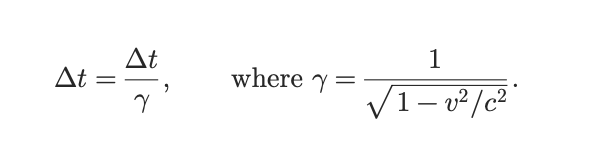
Time Dilation Formula: According to special relativity, if an observer travels at a high velocity $v$ (comparable to $c$) relative to another observer, the moving observer’s time runs more slowly. Quantitatively, the time interval between two events as measured in the moving observer’s frame, $\Delta t’$, is related to the time interval in the stationary frame, $\Delta t$, by the Lorentz factor $\gamma$ as shown herein:
If $v$ is small compared to $c$, $\gamma \approx 1$ and time dilation is negligible; but as $v$ approaches $c$, $\gamma$ grows without bound, and $\Delta t’$ becomes much smaller than $\Delta t$. For example, at $v = 0.99c$, $\gamma \approx 7.1$, meaning a moving clock would tick over only 1 year while about 7 years pass on a stationary clock. This relationship shows that traveling at high speeds is effectively travel into the future of those left behind, since the moving traveler’s aging (and clock) is slowed relative to everyone who remains stationary.
Experimental Evidence – Atomic Clocks and Particle Lifetimes: Time dilation is not just theoretical - it has been experimentally confirmed. In 1971, J.C. Hafele and R.E. Keating flew atomic clocks on commercial jet planes around the world and compared them to synchronized atomic clocks that remained on the ground. After the flights, the moving clocks were found to have fallen behind the stationary clocks by a few hundred nanoseconds, in precise agreement with Einstein’s time dilation predictions. This famous Hafele–Keating experiment was sensitive enough to measure the tiny time differences (fractions of a microsecond) caused by the relatively slow motion (~900 km/hr) of the jets.
Even more dramatic confirmation comes from subatomic particles: muons created in Earth’s upper atmosphere move at speeds near $0.99c$ and have an intrinsic lifetime of only about $2.2~\mu\text{s}$ (microseconds) when at rest. Without relativistic effects, muons should decay long before reaching Earth’s surface. Yet many muons are detected at ground level because time dilation extends their lifetime from the perspective of Earth observers. Likewise, in particle accelerators like CERN’s Large Hadron Collider, unstable particles moving at $>99.9%$ of $c$ live much longer (by factors of ten or more) than they would at rest, exactly as relativity predicts. These observations confirm that time slows down for moving systems.
The Twin “Paradox”: A famous thought experiment illustrating time dilation is the Twin Paradox. Imagine one twin remains on Earth while the other twin travels on a spacecraft at relativistic speed (say 0.95$c$) and then returns. According to relativity, the traveling twin’s clock (and biology) runs slower, so she might return having aged only a few years while the Earth-bound twin has aged perhaps decades. This is not truly a paradox; rather, it reflects that the traveling twin experienced a different spacetime path (which includes acceleration and deceleration phases) and less proper time. In 2019–2020, an actual twin astronaut study was conducted by NASA: astronaut Scott Kelly spent nearly a year aboard the International Space Station (moving ~7.7 km/s or 28,000 km/hr relative to Earth) while his twin brother Mark remained on Earth. Scott’s orbiting clock and biological processes were slightly slowed by both special relativity and weaker gravity (we discuss gravity next), making him end up a tiny bit younger than his twin. Indeed, it’s estimated Scott Kelly’s time dilation amounted to a few milliseconds difference – a direct, if small, real-world twin paradox demonstration.
Forward Time Travel in Principle: All these examples show that travel into the future is possible and happens continuously as a consequence of high-speed travel. By moving fast, one can literally arrive in the far future of others. This form of “time travel” is routine for elementary particles and has been verified for humans on a small scale (as with jet pilots and astronauts). If we had the technology to send a person at, say, 99.999% of light speed on a round trip, the traveler could leap perhaps centuries ahead into Earth’s future (experiencing only months or years of travel time themselves). This is a one-way trip to the future, however - special relativity does not allow one to go back in time or reverse the direction of the clock. For backward time travel, we must look to Einstein’s other theory - general relativity, which encompasses gravity.
General Relativity: Gravity, Space-Time Curvature, and Time Dilation
Gravity as Curved Space-Time: In 1915, Einstein expanded his theory to include acceleration and gravity, formulating the General Theory of Relativity. In general relativity (GR), gravity is no longer a mysterious instantaneous force as Newton imagined; instead, gravity is understood as a manifestation of curvature of space and time (spacetime). Massive objects (like Earth or the Sun) warp the geometry of spacetime around them, much like a heavy bowling ball placed on a taut rubber sheet creates a depression. Lighter objects (like a marble on the sheet, or Earth orbiting the Sun) move along the curves in the warped spacetime. What we perceive as the gravitational “force” pulling the marble toward the bowling ball is actually the marble following the curved geometry. This is a central insight of general relativity: matter (and energy) tells spacetime how to curve, and curved spacetime tells matter how to move.

Mathematically, Einstein’s field equations of general relativity relate the curvature of spacetime (described by the Einstein tensor $G_{\mu\nu}$) to the energy and momentum content (described by the stress–energy tensor $T_{\mu\nu}$):
where $G$ is Newton’s gravitational constant and $c$ is the speed of light. This equation (often written more compactly as $G = 8\pi T$ in geometric units) encapsulates how any form of energy (mass, radiation, pressure, etc.) produces curvature in spacetime. Notably, light itself carries energy ($E = mc^2$ for its effective mass-equivalent), so even light can gravitationally warp spacetime slightly – an idea with important implications we will explore later.
Gravity’s Effect on Time – Gravitational Time Dilation: Just as motion affects the flow of time (special relativity), gravity also affects time. In a strong gravitational field, time runs more slowly relative to a weaker field, an effect known as gravitational time dilation. This is a direct consequence of spacetime curvature: closer to a massive object (deeper in the gravitational “well”), clocks tick slower when viewed from afar. Conversely, far from the mass (where gravity is weaker), clocks tick faster relative to those deep in the gravity well.
For example, a clock on the surface of Earth (strong gravity) will run a tiny bit slower than an identical clock on top of a mountain or on a satellite in orbit (weaker gravity). This is not a biological or mechanical effect but a fundamental shift in the rate of time itself due to different positions in Earth’s gravitational field. The difference is very small for Earth’s gravity, on the order of microseconds per day between ground and orbit altitudes—but it is measurable and must be accounted for in high-precision systems.
Experimental Evidence – Clocks in Gravity and GPS: Gravitational time dilation was first confirmed in 1959–60 by the Pound-Rebka experiment at Harvard University, which detected a tiny frequency shift in gamma-ray photons traveling upward in Earth’s gravitational field (a consequence of time running differently at different heights). In modern times, the Global Positioning System (GPS) provides a practical, everyday confirmation of gravitational (and also velocity-based) time dilation. GPS satellites orbit about 20,000 km above Earth and move at about 14,000 km/hr. At this altitude, Earth’s gravity is weaker than at the surface, so the satellite’s atomic clock runs faster than an identical clock on Earth by about 45 microseconds per day. However, because the satellite is moving relative to Earth, special relativistic time dilation makes its clock run slower by about 7 microseconds per day. The net effect is that a GPS satellite’s clock ticks roughly 38 microseconds faster per day than clocks on Earth. If uncorrected, this time offset would cause positioning errors accumulating to kilometers per day! The GPS system’s designers, aware of Einstein’s theories, built in relativistic corrections: satellite clocks are pre-adjusted to tick slightly slower (at launch) so that once in orbit they keep synchronized time with ground clocks. The fact that GPS works with meter-level accuracy is an ongoing validation that both special and general relativity are correct – the timing corrections predicted by relativity are indeed required for the system to function.
Gravity and the Speed of Light Limit: Einstein’s general relativity also addressed a conceptual flaw in Newton’s gravity. Newtonian gravity was assumed to act instantaneously at a distance. For instance, if the Sun suddenly vanished, Newton’s theory predicted Earth’s orbit would immediately break free of the Sun’s pull. But special relativity forbids any influence from traveling faster than light. GR resolved this by predicting that changes in gravity propagate at the speed of light, just like light itself. In our Sun example, Earth would continue orbiting an “absent” point for about 8 minutes (the time light takes to travel 150 million km) before noticing the Sun’s disappearance – both via darkness and the cessation of gravity. In other words, gravity itself has a finite propagation speed ($c$). In 2017, the simultaneous detection of gravitational waves and light from a neutron star merger confirmed that gravitational disturbances travel at light-speed, solidifying this aspect of Einstein’s theory.
Black Holes – Extreme Gravity and Time: A black hole represents an extreme of spacetime warping. Black holes form when massive stars collapse under their own gravity at the end of their life cycles. If the mass of the collapsing core is large enough (several times the Sun’s mass), no known force can halt the collapse and the density becomes essentially infinite at a point (a singularity). Surrounding this singularity is an “event horizon” – the boundary within which gravity is so strong that not even light can escape. Classically, once anything (mass or light) crosses the event horizon, it cannot return; hence the name black hole. The idea of a black hole arises naturally from Einstein’s equations (Karl Schwarzschild found the first solution in 1916), and their existence is now supported by overwhelming evidence (e.g., observations of stars orbiting an invisible massive object at our galaxy’s center, and the direct imaging of a black hole’s shadow by the Event Horizon Telescope in 2019).
For our purposes, black holes illustrate the limits of gravitational time dilation. Far outside a black hole, time flows normally; but as one approaches the event horizon, time slows down relative to a distant observer. In theory, at the horizon itself, time from an external perspective comes to a standstill. If an observer watches a clock (or an unfortunate astronaut) falling toward a black hole, they will see that clock tick more and more slowly and never quite see it pass through the horizon – it appears to freeze and fade (redshift) as it approaches the threshold. Meanwhile, the falling astronaut’s own experience of time remains normal for them; they would reach the horizon and (ignoring tidal forces) cross it without noticing anything peculiar at that exact crossing moment, but could not communicate back out. This bizarre behavior emphasizes how time is relative to the observer’s frame and how extreme gravity can drastically warp time.
Frame-Dragging – Twisting of Space by Rotation: General relativity also predicts that a rotating massive object will “drag” spacetime around with it as it spins, an effect often called frame-dragging or the Lense–Thirring effect (after the physicists who derived it in 1918). One can visualize this as a spinning ball in molasses – the ball (mass) spins and the molasses (space) swirls around it. In the case of Earth, its rotation very slightly twists the spacetime in its vicinity. In 2004, NASA launched the Gravity Probe B experiment, which used ultra-precise gyroscopes in orbit to measure this frame-dragging effect. The experiment confirmed that Earth’s rotation drags spacetime by a small amount (on the order of milliarcseconds per year for the precession of the gyroscope axes), exactly as GR predicts.
Frame-dragging becomes much more significant near rapidly rotating, extremely dense bodies like rotating black holes. A rotating (Kerr) black hole not only warps space and slows time, but also drags space around with it in a whirlpool-like fashion. In fact, the dragging is so strong near a rotating black hole that there exists a region outside the event horizon called the ergosphere, where space itself is forced to rotate faster than the speed of light (from the viewpoint of a distant observer). In the ergosphere, no object can remain stationary (relative to distant stars) because spacetime is being carried along by the rotation. This phenomenon of twisted spacetime is crucial when we consider the possibility of backward time travel, as it can, under extreme conditions, lead to closed time-like curves.
Closed Time-like Curves and the Possibility of Backward Time Travel
While special relativity and everyday experiments validate travel into the future via time dilation, traveling into the past is a far more challenging proposition. Interestingly, general relativity does not outright forbid backward time travel. The mathematics of GR permit solutions of the field equations that contain loops in time – paths through spacetime that return to their own past. These paths are known as closed time-like curves (CTCs). A time-like curve is essentially the trajectory of an object through spacetime (time-like meaning it always moves slower than light, as a normal mass object would); “closed” means it is a loop. If a closed time-like curve exists, an object following that path could in principle return to an event in its own past. We emphasize that these solutions are theoretical. Whether they can exist in the real universe, or be created or traversed by humans, is an open question.
Rotating Black Holes and CTCs: One known example of a solution with CTCs is the Kerr metric (the solution for an uncharged rotating black hole, found by Roy Kerr in 1963). In the Kerr solution, inside the rotating black hole’s interior (beyond the inner event horizon), space and time are mixed in such a way that some paths can loop back in time. There is even a region of the Kerr solution (the “ring singularity” and its vicinity) where an observer could, in theory, find a trajectory that leads them to emerge into the same space and time coordinates they started with – effectively coming out before they went in. This is a bizarre and unphysical-sounding result; however, it is a valid mathematical feature of the solution. Physicists suspect that realistic conditions (such as collapse processes and instability of the CTC region, or quantum gravity effects) might prevent these closed time-like curves from being usable or even existing in a fully realistic collapsing black hole. Moreover, entering the region of a black hole where CTCs exist would require passage through the event horizon (a one-way journey in classical GR – you cannot come back out to tell about it without exotic physics like wormholes, which we discuss shortly).
The Tipler Cylinder and Cosmic Strings: Another hypothetical way to produce CTCs was proposed by Frank Tipler in 1974. He showed that an infinitely long, incredibly dense, rapidly rotating cylinder (a “Tipler cylinder”) might allow loops in time around it. If you travel around the cylinder in the direction of its spin, you could theoretically arrive back before you departed. Similarly, certain configurations of hypothetical cosmic strings (one-dimensional topological defects in spacetime, if they exist) could produce nontrivial spacetime warping. If two cosmic strings were to pass by each other at high speed, or if one string is infinitely long and another circles it, some calculations suggest closed time-like curves might form around them. These constructions, however, generally require either infinite length or negative energy (to stabilize a finite configuration), and thus may not be physically realistic.
Wormholes as Time Machines: In 1988, physicists Kip Thorne and colleagues published a seminal paper examining whether wormholes (a shortcut connecting two distant points in spacetime) could serve as time machines. A wormhole can be thought of as a tunnel through the fourth dimension, allowing near-instantaneous travel between its two mouths. If one mouth of a wormhole is accelerated to near light speed (or placed in a strong gravitational field) and then brought back, time dilation will cause that mouth to age less than the stationary mouth. When rejoined or stabilized, one mouth’s clock might lag behind the other’s. This time difference means that entering the “younger” mouth would allow one to exit the “older” mouth at a time in the past. For example, suppose in the year 2100 you create a traversable wormhole with both mouths synchronized in time. If you keep one mouth on Earth and put the other on a spaceship that travels at high speed and returns in 2120, the traveling mouth might have experienced only 5 years of time (due to time dilation) while the Earth mouth experienced 20 years. The traveling mouth’s clock might read 2105 when it comes back to Earth in 2120. If the wormhole remains stable and connected, stepping into the mouth that stayed on Earth (2100’s frame) in 2120 could allow you to exit from the traveling mouth at its internal time of 2105 – effectively going 15 years into Earth’s past. While theoretically sound in the framework of GR, traversable wormholes require exotic matter with negative energy to hold them open (to prevent collapse). Whether such exotic matter can exist in the necessary quantities is unknown; quantum physics allows small negative energy densities (Casimir effect) but sustaining a macroscopic wormhole is far beyond known technology. To date, wormholes remain theoretical constructs; none have been observed.
“Twisting” Time with Light – The Ring Laser Concept: Recognizing that energy can curve spacetime, researchers (including our team at LupoToro) have proposed using intense light to generate CTCs in a controlled setting. Light has energy and momentum, so a circulating beam of laser light can create a small gravitational field – specifically, it can induce a frame-dragging effect in the space enclosed by the light loop. The idea is that a very powerful, continuously circulating laser in a ring or cylinder configuration could “drag” spacetime in a swirl, somewhat like a tiny artificial rotating gravitational field. According to general relativity, if space is twisted fast and strongly enough, time within that region could in principle twist into a loop as well (recall that in GR, space and time are intertwined). We derived this result by solving Einstein’s field equations for a hypothetical configuration of circulating light. The mathematics predicts that a light ring can indeed cause a small frame-dragging of spacetime inside the ring. In theory, if the light intensity were increased sufficiently (to enormous levels), the twisting of space could be made so strong that time lines (world lines) within that region form closed loops – effectively a time machine region is created, bounded by the device’s operational start time.
It is crucial to emphasize that the energy requirements for this scheme are astronomical. To have any significant chance of forming a closed time-like curve, the laser would need to contain the energy of perhaps a stellar-scale mass or more, condensed into a circulating light beam in a manageable volume. This is far beyond our current capabilities (even the world’s most powerful lasers today are many orders of magnitude too weak). Therefore, while the theory does not obviously violate physics, building such a device with today’s technology (or any foreseeable technology) is impractical. Nonetheless, the concept is valuable scientifically: it shows a concrete (if extreme) way that light can affect time, linking back to our earlier point that light’s energy contributes to gravity. Should technology ever allow energy densities approaching this realm, the ring-laser time machine idea could be experimentally tested. Our immediate research goal is more modest: we aim to detect the tiny frame-dragging of spacetime caused by circulating light (a measurable but small effect), as a proof-of-concept that light can do what rotating matter does (frame dragging). Such experiments are on the cutting edge of gravitational physics. They also bridge to quantum optics, since very small scale or quantum effects might become relevant when classical and quantum fields interact in extreme ways.
The Principle of Self-Consistency vs. Many Worlds: Assuming, for the sake of exploration, that a closed time-like curve (a loop in time) can be created or accessed, could one change the past? This question leads to the famous grandfather paradox (what if a time traveler went back and prevented their own grandfather from meeting their grandmother, thus preventing the time traveler’s own birth?). There are a couple of ways modern physics contemplates resolving such paradoxes, though we do not have experimental evidence to confirm which (if any) is correct, since we have not yet actually sent anything or anyone on a closed time loop.
One possibility is the Novikov self-consistency principle, which posits that if time travel to the past is possible, the universe somehow prevents actual paradoxes from occurring. You may be able to travel back, but you cannot change recorded history; any actions you take were always part of history to begin with. In a self-consistent universe, if you attempted to prevent your grandfather’s marriage, something would invariably happen to thwart your plans (a series of events conspire such that history stays consistent and you are still born). This principle essentially says that time is fixed along consistency lines; you can participate in past events, but you cannot alter the outcome known in your original time. This idea fits naturally with the “block universe” view of time implied by relativity – that past, present, and future all exist in a four-dimensional block and are unchangeable, just experienced differently by different observers. In a block universe, time travel might be possible, but it would be like traveling to a different location on a map: you cannot rewrite the map, you can only observe or fulfill what’s already there.
Another possibility is offered by quantum mechanics, particularly the Many-Worlds Interpretation (MWI) of quantum theory. Quantum mechanics, unlike classical physics, introduces fundamental uncertainty and multiple possible outcomes for events. According to the MWI (proposed by Hugh Everett in 1957), each quantum event with multiple possible outcomes actually causes a branching of the universe into parallel timelines – one for each outcome. These parallel universes are usually considered non-communicating, but they provide a convenient logical escape from paradoxes: If a time traveler changes something in the past, perhaps that action simply creates (or occurs in) a new branch of reality, separate from the one the traveler originated from. In this scenario, consistency within any single timeline is preserved (no paradox arises in the original timeline because the timeline where the grandfather was harmed is a different branch), but the traveler now finds themselves in a new branch where history diverged. The original timeline continues unaltered (perhaps the traveler disappears from it entirely when going back), while the new timeline reflects the changes. For example, in our grandfather paradox: when you go back to 1950 and intervene in your grandparents’ lives, you have effectively moved onto a different world-line. In that new timeline, you might indeed prevent your own eventual birth – but that would not prevent you from having existed in the original timeline you came from. It only means that in the new branch, “another you” will never be born, and you yourself possibly become a causally disconnected anomaly (with no past in that branch). Though this scenario raises its own questions, it avoids logical contradiction because no single individual timeline ever violates consistency – you just hop from one to another.
It is important to note that Many-Worlds vs. single timeline consistency is still a matter of interpretation and theoretical debate. Both approaches rely on concepts beyond currently testable physics. If time machines were ever realized, what actually happens may be something we haven’t even conceived, or nature may enforce consistency in ways we don’t expect. Until we have experimental evidence of backward time travel, these paradox resolution mechanisms remain speculative. They do, however, illustrate that physics is not blind to the conceptual challenges of time travel – serious thinkers have developed frameworks that attempt to handle them within the laws of physics as we understand them.
Practical Limitations and Future Outlook
Enormous Energy Requirements: Perhaps the most glaring limitation in turning time travel (especially to the past) from theory to practice is the energy scale required. Special relativity tells us that reaching significant fractions of the speed of light requires tremendous energy. To send a crewed spacecraft to, say, $0.5c$ or $0.9c$ would require propulsion energy far beyond what chemical rockets can provide. Advanced propulsion concepts (fusion, antimatter, or even beamed laser propulsion) are being studied to reach high speeds for future space travel, but these remain at the experimental or proposal stage. For backward time travel via spacetime manipulation (wormholes, Tipler cylinders, or circulating light devices), the energy and mass requirements are even more daunting. Creating a stable wormhole might require mass-energy equivalent to a small star and negative energy materials that we do not know how to produce in macroscopic quantities. The ring laser concept, while fascinating, demands laser power and intensity on a scale that would vaporize any known material and perhaps form a black hole before achieving a time loop. In essence, we are limited by our ability to manipulate energy and mass – our current technology is many orders of magnitude too feeble to significantly bend spacetime on demand.
Engineering and Material Challenges: Aside from raw energy, there are practical engineering issues. A spacecraft for relativistic travel needs not only energy but also to protect passengers from hazards (cosmic radiation and collisions with dust at high speed can be catastrophic due to enormous kinetic energy release). For wormholes or exotic space-time constructions, we are entering regimes of physics that might require a quantum theory of gravity to fully understand – something we do not yet have (unifying general relativity with quantum mechanics is one of the biggest open problems in physics). Additionally, containing or guiding intense energies (like beams of light or fields of extreme density) would require materials and control mechanisms far beyond what is available. We might need to discover new states of matter or employ self-gravitating structures to even attempt such feats.
Causality and Unknown Unknowns: There is also the existential question: if backward time travel is possible and has no cosmic prohibition, where are the time travelers or messages from the future? The absence of any evidence of visitors from the future could suggest that backward travel is impossible, or extremely limited (e.g., perhaps one can only travel back to the point when the time machine was first activated, which would explain why we haven’t seen visitors from before such an activation exists). Indeed, theoretical analyses of devices like wormholes or circulating light loops indicate a common feature: a time machine cannot send you back to a time earlier than the creation of the time machine itself. For instance, if a circulating laser device is turned on in the year 2100 and runs continuously, it might allow travel or communication between future times and any time back to 2100 – but not before. This means one cannot go back and, say, kill Hitler or witness the building of the pyramids with a time machine that we create in the 21st century; you could only visit times after the machine came into existence. This limitation is actually a relief in some respects, as it automatically avoids paradoxes about altering the distant past and might explain the lack of time travelers in our era (if no such machine existed before now, they couldn’t come to visit “before the machine”). Nonetheless, it also limits the utility of any time machine: it’s more like a tunnel through time that opens at creation and can connect only to times after its creation. Some have speculated that if an advanced civilization elsewhere in the galaxy created a time machine eons ago, and we found it or connected with it, then perhaps we could travel farther back (to when their machine was made). This remains purely speculative.
Forward Time Travel and Human Experience: Looking on the brighter side, time travel to the future is not only possible but essentially unavoidable at small scales. Every astronaut in orbit is aging just a tiny bit slower than we are on Earth. If one wanted to “time jump” into the future significantly, the only currently known method is to move very fast or stay in a high-gravity environment (like near a neutron star or black hole) and then return. High gravity is impractical for a human trip (you couldn’t survive near a black hole’s horizon for long; also getting out of its deep gravity well is nearly impossible without extreme propulsion). High-speed travel is more plausible: concepts like the “interstellar ark” or relativistic starship have been explored in science fiction. For example, a journey to a star 100 light-years away at 99.99% of light speed would take a bit over 100 years as seen from Earth, but the travelers might experience only, say, 10 years of subjective time on board. They would land having effectively leapt 90 years into Earth’s future compared to their own aging. Such ideas may come into the realm of engineering possibility in the far future if propulsion technology advances drastically (e.g., matter-antimatter engines or advanced light sails driven by planet-sized lasers).
However, there is a poignant consequence of one-way future travel: the “time traveler” is essentially leaving everyone behind. As noted in thought experiments (and portrayed in science fiction films like Interstellar), an explorer who spends time moving near lightspeed will return to find that perhaps generations have passed on Earth. Friends and family could be long gone or much older. Society would have advanced without them. This social and personal cost means that even if we could do relativistic human travel, it would not be undertaken lightly. The motivation would have to be extremely strong (e.g., interstellar exploration with no expectation of coming back to the same era).
The Quest for Theoretical Clarity: On the theoretical frontier, physicists continue to investigate the nature of time and its relationship to the fundamental laws. Efforts to reconcile general relativity (a classical theory) with quantum mechanics (which rules the subatomic world) could shed light on whether time is discrete or continuous, whether causality is an inviolable principle, and whether new effects (like quantum gravity phenomena) forbid or permit time loops. There is speculation that a full theory of quantum gravity (such as string theory or loop quantum gravity) might automatically eliminate the paradoxical solutions of GR or make them physically benign through quantum effects. Some calculations suggest that quantum effects could “censor” time machines (the Chronology Protection Conjecture by Stephen Hawking posits that physics will prevent CTCs from forming, perhaps via infinite energy requirements or vacuum instability). Only a deeper theory can tell us if that is true.
Conversely, the very fact that general relativity allows time loops in principle forces us to confront their possibility and meaning. This has driven much fertile research into cosmic topology, causality conditions, and quantum information in time-dependent backgrounds. Studying time travel in theory has led to insights in computability and information theory(for instance, the question of whether P = NP changes if a computer can send answers back in time), and into the profound links between gravity and quantum mechanics (like the ER=EPR conjecture, relating wormholes to quantum entanglement). Thus, researching time travel is not just a fanciful pursuit; it pushes the boundaries of physics and forces clarification of concepts of time, determinism, and the structure of the universe.
The current scientific understanding of time travel can be divided into two regimes: forward-in-time travel, which is well-understood and experimentally verified (time dilation through motion or gravity), and backward-in-time travel, which remains speculative and faces enormous theoretical and practical obstacles. We have concrete evidence that we can affect the rate at which time passes (relative to other observers) by changing our velocity or gravitational potential. This means the “future is open” in the sense that one can leap ahead given sufficient technology. By contrast, traveling to the past would require exploiting extreme gravitational geometries or quantum phenomena that are at the edge of known physics. General relativity’s equations tantalizingly hint that such pathways might exist (in warped spacetime around rotating black holes or via wormholes), but nature has guarded them behind conditions (singularities, horizons, exotic matter) that we are far from accessing or understanding fully.
At LupoToro’s Deep Research Division, we will continue to monitor and contribute to advances in both relativity and quantum physics that inch us closer to discerning whether time travel to the past is fundamentally allowed or disallowed by the laws of nature. In doing so, we emphasize credible science: each step must be supported by rigorous theory or experiment. The coming decades will see improved precision in experiments (e.g., ever more sensitive clocks and instruments testing relativity), potentially new states of matter or energy, and perhaps even modest attempts at warping spacetime in the lab. While a full-fledged time machine is not on the immediate horizon, our understanding of time and space will surely deepen. And as history has shown, when knowledge deepens, technologies that once seemed like science fiction can suddenly become reality.
Time travel remains a profound mystery and a grand challenge. Its study touches on the core of physics – uniting gravity, quantum mechanics, and the nature of the universe. By approaching the topic with scientific rigor and healthy skepticism, we transform the dream of time travel into a pathway for exploring fundamental physics. The journey toward understanding time travel is, in itself, a journey through the deepest questions about time, space, and reality. As physicists, we continue that journey, one experiment and one insight at a time, ever mindful of both the promises and the paradoxes time travel entails.
